terça-feira, 3 de março de 2015

Balázs Delbó : an open talk about Ballet, Films, emotions and "Stage Fever"


Balázs Delbo's’s work on film has been fascinating me since quite a long time. For someone who understands ballet and dance as a “language” it is easy to understand why. For someone who is not quite “in touch” with those forms of art, it may take a little longer to be able to articulate one’s feelings about it. But the fascination never diminishes. To be very honest, I do believe that his work, so special, deserves the adjective “exquisite” – but what else to expect from an open-mind that, uncommonly to most dancers, love other art forms and enjoy, for example, Elvis, Woody Allen, Jazz, Billie Holiday, Norah Jones and films of Clint Eastwood just to name a few? Not forgetting the fact about his hard work and strong auto didatic ways.

But, in order to give this “portrait” a touch of cinema, let’s start it as a script.

Time: Friday, February 27th, 6:30 pm
Place: «Café Westend», an old-fashioned Viennese Café which seems still to hide the ghosts of many generations that were either departing from or just arriving at the “West-Bahnhof”. Vienna.
It is loud, the piano-player is trying to be heard and is playing also very loudly.
Mr. Delbó arrives.


Looking at him quite quickly, one “sees” his full awareness of the room, its location, its form, its noise, its single details… he greets me, sits down and then, turning to me, makes me feel that I had, in spite of his full awareness to the surroundings, all of his attention and concentration, much to the contrary of superficial and unconcentrated “interview subjects”.
He had “arrived”. Our talk starts.

. Before we start talking about the movie-maker, let’s start, as the song says “at the very beginning, a very good place to start… tell me about the dancer Balázs Delbó

“I was quite a late bloomer… you see, my parents were dancers and always when asked if I wanted to follow into their steps, I gave a strict “no” as an answer. After a summer-camp, in which my mother was teaching, I got in touch with young pupils my age and all of a sudden I decided to dance. My mother said “but now it is too late”. You see, I was already 14 years old… Hard work pays and four years later, quite unusually for such a short period of training, I was admitted into the Opera House in Budapest”

. I remember quite well watching an Opera Ball in Vienna and witnessing your entrance as “Mozart” – how did that feel like?

“Yes, I was already dancing at the Viennese Opera, and to be quite honest. It felt scary… you see, the quick running down the stairs, 7000 people in the Opera watching you, many more in front of the TV… I just thought: “don’t slip, whatever happens, just don’t slip”

. And then after some years you stopped dancing, put your slippers away and finished your career as dancer… what happened?

“ I had had an injury which, with the passing of the years, became very bad and then worse… It led me to a difficult situation in which I had to make a choice and perhaps to the most difficult day of my life: you see, I had made up my mind, then I went to the Opera to quit my job, my career, my world. I entered the Opera, the biggest and most important “Theatre” in Austria, a soloist and Ileft it as a nobody, a foreign jobless nobody… all this within some hours… “
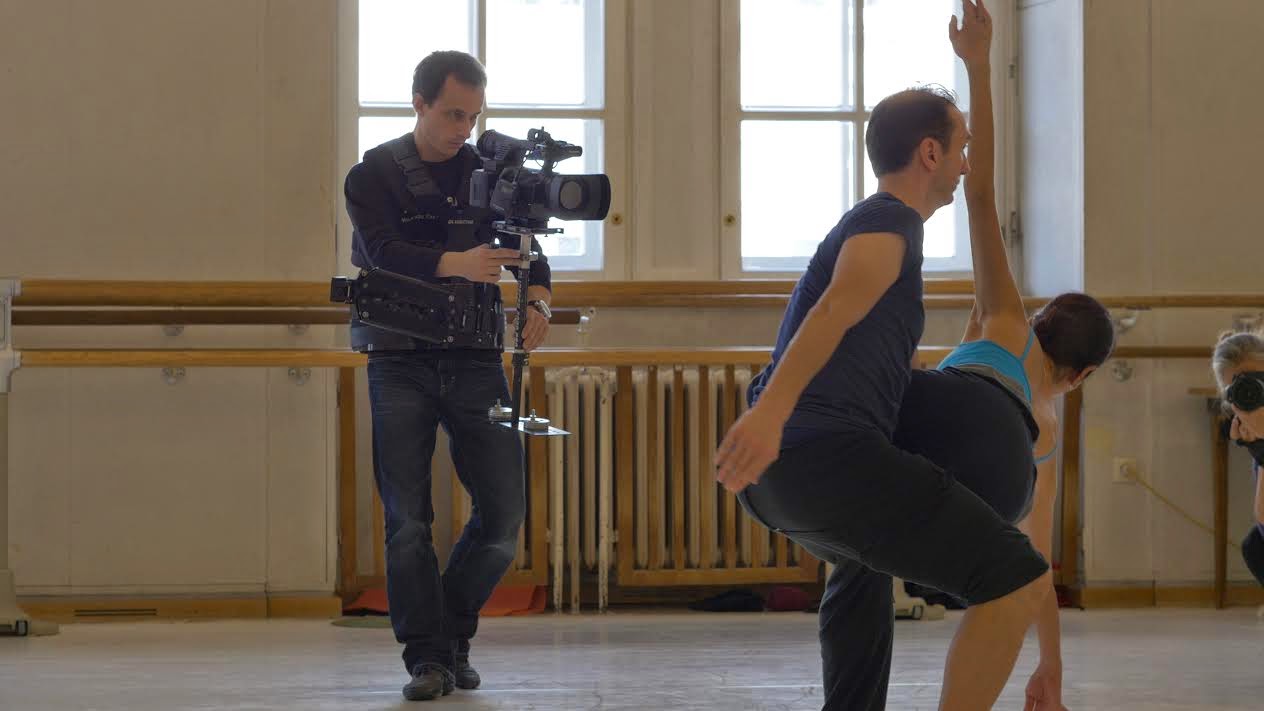

. Yours are the most sensitive films about ballet that I had ever watched – of course we do have lots to thank due to the fact that you are a dancer but it is more than that. How do YOU feel about that?

“Knowing my way around a ballet is a tool that I would not like to miss. But you are right… it is more than that. When I started filming, I wanted do develop a new language… I started thinking “let’s make trailers” – have you ever noticed how sometimes trailers of American movies can be even better than the film itself? - yes, trailers and not “extremely short pieces of ballet… I love, most of all, to “tell stories”. Also when they are very condensed, they must fit into the times in which they are being told. Time, technique, countries, feelings change. My way of “story-telling” will be preserved forever, as long as the film exists. I love eyes, close-ups, emotions being shown… And they are there on my films, developing a new language for dancing films – bringing the audience much closer to the dancers, bringing the magic of the piece much closer to the audience… This is film. If I want to watch the performance from far away, the classical way, I can always sit in a Theatre“


. But this is exactly point that I miss, worldwide, today, Feelings: There seems to exist a cult to technique in which dancers forget that technique by itself is just a tool to achieve artistry… and their artistry includes also the comprehension of the character they are playing and its feelings… a fact that has been neglected many times during the last years, also here in Vienna...

Balázs Delbó gives a short sight and his eyes become gloomy, his usual electricity while talking seems to leave him for a while – all of a sudden the sounds of his brain “machinery” silence - it seems he has either heard this affirmation or thought about it often. He says simply

“Yes”

Enough to that.


. Your very specific camera angles show more of the movie making mind than of the dancer. Was Cinema always a passion?


“ Yes, and I want to catch people everywhere – and you can do that nowadays. At home, on the bus, on the tram, in the Underground. But you have to adapt your language to these “other” mediums. You cannot, that is definite, work the same way as if you were making a statement in the classic sense of a film that is being shown in a Cinema House. But you have to feel it. There is no recipe, “formula” with the right ingredients to make the “perfect Movie”, to tell the story “right”. You have to feel it. This applies also to script-writing. You can make courses, learn the “dos and don’ts” but at the every end it is up to you… the concept of the right “timing” (in full accordance to your own story-telling) is inside you, nowhere else.


. What about “Stage Fever”? I was lucky enough two watch two “previews”. But since then we have not heard about the movie… when is it to be in a cormecial circuit?

“There are still some copyright questions – music, choreography etc. – to be clarified but I hope that the audiences will be soon able to enjoy it!”

. I do hope so. It is an incredible testimony to the “Legris era” as well as to the many marvellous talents that are now on the company. By the way, “Live Stream” at the Opera – a huge project I guess…

“You can say that. It was quite exhausting but the results made us so happy that they were worth it. By the way I am not only responsible for the ballet live streams as a director but also for the break Spots during Opera performances.

. Tell me more about your “visions” for the future.

“ I want to bring the audiences more and more into the stage – yes, into it – until one day they’ll finally enjoy the ballet not from “the front” or “backstage” but being in it, as if they were a part of it… but that is really another Story!

. I want to thank you, Balázs Delbó, for this informal chat and leave you here with the previews of "Stage Fever" - the documentary about a mark in Vienna's Ballet history: Manuel Legris' footmarks here in Austria.


Stage Fever - TRAILER 1 - on stage Videos from DelbeauFilm on Vimeo.

">

">


Stage Fever – TRAILER 2 - On stage videos from DelbeauFilm on Vimeo.


Stage Fever - Explosion - On stage videos from DelbeauFilm on Vimeo.

domingo, 22 de fevereiro de 2015

Over the Rainbow: Minha mãe, a música e o piano… uma tertúlia (MUITO) pessoal…


Como descrever a emoção que a nossa reação com a música trás? Recordações maravilhosas, momentos indescritíveis de harmonia (em todos os sentidos), um prolongamento da nossa alma… e tanto mais...

Toda a vida, recordo-me de um piano em casa, de muita música e harmonia... Mas um dia minha mãe, por motivos pessoais seus, fechou o teclado, passou a chave e despediu-se da música. O piano foi vendido, as partituras foram embaladas, colocadas num maleiro e toda uma fase de sua vida foi esquecida...


Há pouco tempo atrás porém ela “redescobriu” depois de mais de 40 anos o piano e aos seus quase 85 anos volta à sua rotina diária de tocar por toda a parte da manhã.
Ela está de novo "de bem" com o piano e exatamente isso é o que importa.

Agradeço esta emoconante redescoberta a amigos muito queridos: Tainá, Iris e Ronir… não tivesse sido aquele almoço maravilhoso e saboroso do dia 7 de janeiro na casa de Tainá, não tivesse sido a “insistencia” carinhosa para ela pelo menos sentar-se ao piano, não estariámos passando por um momento, uma fase na qual ela está acariciando sua própria espiritualidade, alimentando sua alma.
E feliz. Simplesmente, omo se pode constatar neste curto video feito no dia 6.2. aqui em casa… ela e seu pianinho novo…

Não existem coincidencias:
Pensar que ela sentou-se pela primeira vez e tocou “Over the Rainbow” na casa de Tainá e Tainá exatamente fazendo “O mágico de Oz” na Volksoper… O que mais dizer?

Sim, só «if happy little bluebirds fly, beyond the rainbow, why oh why can’t I ?»

Um lindo começo de semana deseja, um feliz
Ricardo Leitner

terça-feira, 17 de fevereiro de 2015

Marília Pera: (N)a cara do espelho


A maioria dos meus amigos sabe que eu, um dia, adorei Marília Pera... e sua voz!

Quando, ainda adolescente, “acordei” para o mundo teatral Marília passava por uma incrível fase, acompanhada, assim como Marco Nanini, pela maravilhosa professora de fonética, impostação e canto “Dona” Fernanda, com quem tive o prazer e privilégio de fazer aulas.


Quando revi Marília há poucos anos em “Alo Dolly” no João Caetano fiquei chocado:
Presenciei, ao vivo, o que já havia sentido, previsto em videos (como sua homenagem à Carmen Miranda, também no João Caetano).
Sua voz tornou-se extremamente fanhosa e caricata. Como se a cantar ela estivesse fazendo uma caricatura do que um dia foi...

Ela è “entoada”, não perdeu sua técnica popular e não grita (bem, hoje em dia existem microfones no palco) mas transformou-se e “parou” naquele clichè de "carióóóca" que tanto insiste em colocar nos palcos (o que em “Dolly”, que se passa em N.Y. em 1890, nao tem o que haver! Até mais em "tournèes" em outros estados brasileiros) inclusive na sua voz… fanhosa, gasquita…

Mas estes devem ser recursos que usa para continuar cantando nos palcos, depois de ter cumprido mais de 70 - o que, pensando-se em termos de energia física, é fenomenal!

Para todos, de gerações mais jovens, que não conhecem a Marília “crooner”, aqui uma amostra do que ela um dia foi, num Show que assisti no Teatro Casa Grande chamado “Feiticeira” (acho quem em 1976… ).

Um dos textos mais maravilhosos "do mundo" (amo, mesmo que o "Castellano" seja bastante questionável... Na realidade um „portuñol“ de grande inventividade!!!!), atribuído hoje à Nana Caymmi (?!? é dela????). Será? Sei que ela cantou-o, anos depois…

Aqui uma esplendida Marília numa intepretaçao que me é muito querida, cara e que me desperta muitas memórias boas:

Às vezes pergunto pra cara do espelho
Que olhos são esses
Que sonhos não mostram
Que medos disfarçam
Que dores escondem
Nenhuma resposta
Só novas perguntas

Que un dia yo me vea
En la cara do espejo
do jeito que eu sou
no da forma que pienso que quiero que sea…

Y nunca me esconda de
mi la procura de un mas que perfecto


Quisiera quisiera
Quisiera quisiera
Quisera saber

Se deuses e santos
São loucos que pensam
Ser deuses e santos
Y os ojos do espejo refleten su luz

Que um dia eu me veja
Na cara do espelho, coberta de trapos
De medos, de cores, de falsos amores,
Morrendo e nascendo
No mais que presente
Vivendo, vivendo
Vivendo, vivendo


sexta-feira, 6 de fevereiro de 2015

Première: Verklungene Feste/ Josephs Legende - 2015, Feb. 04th


If you love John Neumeier and Richard Strauss this should be a treat for you...


„Verklungene Feste“:

a piece that could be well described as „The party is over“ is a very interesting musical work: during the Second World War Richard Strauss orchestrated some dances from the 18th Century, music written by the baroque composer François Couperin (that is the reason why one is not “reminded” of Strauss while hearing it, a sort of commentary that I heard many times during intermission) and managed to create a sort of “intemporary” form of music. If I may say so.

John Neumeier’s choreography is clever (it should not to be confused with Pino Mlakar’s choreography to the same music and that carried the very same name and that opened in Munich in 1941). It is the sort of work you could compare to a fluent speech – one in which you have also the freedom to be sometimes repetitive – for example like his use of flexed feet during the first 15 or 20 minutes of it.

Having seen this work before, my expectation was a different one and my praise goes this time specially to the “casting” of the dancers:

Maria Yakovleva and Vladimir Shishov as well as Irina Tsymbal and Mihail Sosnovschi “carry” the more dramatic, “juicy” parts.


Miss Yakovleva, a very strong presence on stage (and, by the way, quite clever with her short hairdo that gives her another dimension) developed her artistry even more during the past season. Surely her period of recovery after last season’s accident gave her lots of time and possibilities to “go inside herself” and redefine herself.

Mr. Shishov, versatile, strong Mr. Shishov, impressed very much in this “dark role”, in which a bitter, angry mood is needed. Nearly scary.
It was so interesting to watch this wonderful Danseur Noble, the gentle prince portraying such a character.


Lovely Miss Tsymbal, developed ther role creating a complete new persona for herself on stage – a beautiful new “reading” of the part that nearly “reinvented” Miss Tsymbal as a performer. Drama was added to her charming delicacy… and, surpinsingly, there was all of a sudden this hurt, suffering, mature woman on stage.
Fascinating!


Mr. Sosnovschi – what can I say? – once more showed us his emotional vitality combined with precision and musicality. At the end of the piece, when all dancers stand in the back of the stage, either reclining or standing on the back wall, Mr. Sonovschi’s face stole the show because he was the center of all attention – and I, at last, found the words to describe a certain quality that I had known, but was not quite able to express:
Features that bring us the memory of a Modigliani’s painting.
Yes. The actor inside the dancer.


Kiyoka Hashimoto and Masayu Kimoto: dancers that always insist in “outpassing the last performance” and always manage to do that. Greatly!

Liudmila Konovalova and Davide Dato: lightness, elegance, speed, partnership, great technique and stage presence. AND RAPPORT WITH THE AUDIENCE!!!!!! Chapeau!


The most intelligent part of casting is yet to come: the “combination” of Eszter Ledán and Robert Gabdullin was the most clever, imaginative step of the creative process on this lovely evening: Miss Ledáns “fragility” (even tough she is a very strong dancer) combined with Mr. Gabdullin’s debonair charms were a very clever piece of casting. I had never seen them dance together and I wonder if Mr. Legris’ eyes also caught what mine did. I just hope to be able to look forward to the creation of another stage partnership which could bring much joy to the audiences.

The “Corps de Ballet” was exciting, dynamic – presences that begin to create a following like Nikisha Fogo, Natascha Mair, Laura Nistor, Richard Szabó and especially Dumitru Taran were there.

For me one of the beautiful things of such an evening – a Premiere one in which many “ballet fans” attend to – is also to hear the comments of member of the audiences about the dancers and, if I may say so, the names that I have just mentioned were being strongly discussed.

Joseph’s Legend (Josephs Legende)

To beging with just a few information, just for the record:

Joseph’s, Potiphar’s and his wife’s story is a very known one in the Book of Genesis: Joseph, who had “visions” in form of dreams, was very much loved by his father and envied by his half brothers, who kidnapped him and sold him to Potiphar, a high official to the reigning Pharaoh. Potiphar makes Joseph the head of his household, but Potiphar's wife, furious at Joseph for resisting her attempts to seduce him, accuses him falsely of attempted rape. Potiphar casts Joseph into prison, from where he later comes to the notice of Pharaoh through his ability to interpret the dreams of other prisoners.

By the way: Potiphar's wife has no name: This is a way of making her seem less real… Medieval “Sefer HaYashar“, a commentary on the Torah, gives it as Zuleikha, as do many Islamic traditions and thus the Persian poem called “Yusuf and Zulaikha“ from Jami's Haft Awrang. There is no doubt that she, Potiphar’s Wife, stands as a symbol of Egypt - its decadence and cruelty, as openly interpreted in the Genesis.

Well, so much to the Genesis and to first part of this fascinating story…

The Legend of Joseph, Op. 63, is a ballet in one act for the Ballets Russes based on the story of Potiphar's Wife, with a libretto by Hofmannsthal and Kessler and music by Richard Strauss. Composed in 1912/14, it premiered at the Paris Opera on 14 May 1914.
I, personally, love one comment of Strauss, while composing “Josephs Legend” – specially if you think about Mr. Neumeier’s “reading” of it:

“Joseph isn't progressing as quickly as I expected. The chaste Joseph himself isn't at all up my street, and if a thing bores me I find it difficult to set it to music. This God-seeker Joseph - he's going to be a hell of an effort!”

End of the quote and (again) well, so much to historical references…

I am going to try an interpretation of what I just I had the chance to witness before yesterday.
I cannot really remember what I witnessed in 1977 at the State Opera, as I watched this piece for the first time while I happened to be visiting Vienna with my parents, with Kevin Haigen, Judith Jamison and Karl Musil. Even if I was already dancing I feel that I was too young. But I remember being extremely bored. That did not happen this time.

I am fully conscious that Mr. Neumeier’s work continued in its process of development being fully relaunched (Note: Albert Kriemler’s costumes are amazing!) and I am nearly certain that this was not the last version of it which I will be able to watch.
An amazing process, as Mr. Neumeier himself said during his Speech after the Show.

This new reading contains a theme that, if I may say so, no critic or Ballet commentator has ever wanted to refer to: Its homoerotic content.


As the scene opens and we are confronted with Potiphar’s “court” we begin to be fully aware of the fact that we are not understanding if Potiphar is looking at the women – or at the men.
But we are able to quickly jump to conclusions when Joseph is brought to him inside the carpet. We see that Potiphar’s attraction to this chaste boy is much more than “love for a servant to his household”.

Lovely Members of the cast: charming Laura Nistor, Nikisha Fogo and Céline Janou Weder, strong Leonardo Basílio, Jaimy van Overeem (extremely charming in white) as well as Ryan Booth. And the always beautiful and unique presence of Flavia Soares.

Then the nameless Wife enters the scene. We realize quite quickly that she and Potiphar are having “marriage problems” and, since we have been introduced to his suggested sexual tendencies just right before, we know exactly what might be going on.
Then the “drama” starts and the love triangle between Potiphar, his wife and Joseph goes on… just to be interrupted here and there by his “dreams” about the angel – another strong homoerotic display.

Like in “Ben-Hur” (the film), as I thought, most of the dancers are/were not aware of the “effect” of what they are/were doing on the audience…
Good direction leads to that.
Funny that Mr. Roman Lazik’s Potiphar reminded me so much of Charlton Heston’s untallented Ben Hur.
An actor that was not aware that he was playing a “gay” character and kept on going, highly mannered with his chin up.
That is the problem with predictable acting/dancing.


Kirill Kourlaev, in top form physically as well as in his sensibility as an interpreter, gave a marvellous performance. No question about that. The audience was extremely touched by his performance. But it always is. Mr. Kourlaev is a very beloved dancer. Deservingly.

Rebecca Horner, a dancer that I admire – not only because of her strong technique but also because of her intellectual approach to the roles she is playing (I like intelligent dancers!) - gave us an unforgettable “Wife” as present. Not an easy job being compared to Judith Jamison, I say. She was strong, smashing, daring… and extremely feminine altough she sometimes, while dancing with Joseph was the "yang" part of the duo – She did an extremely good job, even dealing with the senseless running at the very end of the play. Miss Horner “light years” away of being badly directed in pieces like “Sheherazade”.


Denys Cherevychko… lovely, talented Mr. Cherevychko… Amazing how he mastered the role of Joseph – and I am not just speaking about his technique which is very known to the Viennese, French and other audiences. It is not an easy task for such a master of male “Bravura” also to convey a feminine side to the character (which is quite required in this new “reading” of the piece). Most of all I was impressed by his mastering of a certain “yin and yang-Balance” combined with the technical demand of the role that accompanies him throughout the evening – and how tiring this must be. He never leaves the stage and can only “rest” perhaps for three minutes…

End of the evening: Applause like I have not experienced in many, many years. A huge success. The screaming was so intense that I thought that I was in a soccer play. Incredible.
Another “Conquest” of the Legris’ era in Vienna.

And about the audience’s reception of “Joseph” again:
I begin to understand Andrea Amort’s words about a “wiener Ballet” (a Viennese Ballet) even tough “Joseph” (like a “so-called” classic like “La Dolce Vita” from Fellini) is a piece of Ballet that is quite “dated” on its content, message, language in spite of its new “reading”. The effect on the Viennese audience is quite simple to describe. We live in a country that refuses to adjust to newer times – but I will not go into that, just read some Austrian history and you will know what I mean.


Sincerely

Ricardo Leitner

Copyright: All Programme Pictures Wiener Staatsoper. Première Party Pictures Ricardo Leitner.

sábado, 31 de janeiro de 2015

Ava Gardner: Can't help lovin' that man of mine (Showboat, MGM 1951)

Um dia desses comentávamos sobre Helen Morgan e seu talento...
Uma coisa leva à outra e me lembrei que Ava Gardner interpretou "O" papel maior de Helen Morgan... a infeliz Julie...

Esta cena reune vários elementos que lhe dão um valor todo especial e a fazem única:

O sol amarelo e quente da Califónia num Take exterior, coisa rara na época, que lhe dá uma cor única, uma cor quente toda especial e envolvente, o maravilhoso trabalho de camera, a belíssima Ava Gardner que apesar de levar um tipo de vida repleto de “excessos” (estou falando do seu consumo alcoólico) preservava ainda uma beleza singular, a canção mais do que especial de Jerome Kern, o mise-en-scène e, neste caso especialmente, o magnífico e simples arranjo assim como a verdadeira voz de Ava… (que muitos anos depois inspirariam Barbra Streisand e - pasmem - Stevie Wonder tocando a "Harmonica", para a gravação de um álbum chamado "Broadway" no qual interpretaram juntos "can't help lovin' that man of mine).


Sim, no filme Ava foi surpreendentemente dublada por uma cantora chamada Anette Warren. Um fato infeliz.

A MGM não confiou em seu talento e Ava, depois de meses de ensaios e preparo, só tomou conhecimento disso durante a premiére do filme.
Humilhante.

Triste este tipo de traição…

Aqui, Ava e sua voz, que reencontram o público...

sexta-feira, 30 de janeiro de 2015

Comentários...


Estou super triste...

apaguei por erro todos os comentários (mais de 8 mil) que haviam entrado no meu Blog,
comentários para todo meu trabalho desde 2008, para artistas magníficos ...

uma perda lastimável... irreparável...

nem sei expressar o que sinto...

já olhei e pesquisei tudo mas a opiniao geral, também do Blogger, é que é impossível regastá-los depois de apagados...

sao sete anos de comentários... sete anos...

Triste...


quinta-feira, 29 de janeiro de 2015

Helen Morgan: What wouldn't I do for that man? (1929)


Helen Morgan, torch singer, cantora das canções de vítima, das dependentes emocionais, das sofredoras…


Atriz que encontrou em Julie (de «Showboat») sua definitiva interpretação de uma vítima, de uma dependente emocional, de uma sofredora… papel com qual sempre foi identificada – e com o qual provávelmente se identificava.


Helen que morreu aos 41 anos de idade de cirrose pela fato de ser uma vítima, uma dependente emocional e uma sofredora afundando suas amarguras e frustrações dentro de garrafas de alcool…

Aqui numa clássica interpretação, num momento de esperança no qual indagava o que não faria pelo seu homem…
Pena só que estas esperanças eram sempre tão efemeras, como tudo na vida...

sábado, 24 de janeiro de 2015

Salomé: Richard Strauss & Oscar Wilde...


“Salomé” de Richard Strauss...

Baseada na peça escrita (em frances) por Oscar Wilde é, infelizmente, famosa para o publico não conhecedor sómente pela cena da “Dança dos sete véus”… Uma pena e injustiça com o trabalho de Strauss que com “Salomé”, e “Elektra”, conseguiu uma nova dinamica para a Ópera moderna elevando-a à uma nova dimensão, apesar da forte agressividade e brutalidade com que ambos relatos, temas são tratados…


Quando penso na cena final de “Salomé”… na qual Salomé declara seu amor – e beija a cabeça recém decapitada de João Batista/Jochanaam… fogem-me palavras e penso no choque em que deve ter causado ao público germanico da Austria e Alemanha, países em que desde centenas de anos é considerado de “bom tom” não se falar ou de emoções ou sentimentos (aí minha simples explicação para o uso desenfreado de anti-depressivos por aqui… ).

Deve ter sido, ainda é, um choque para as platéias assistir, presenciar, viver tal dilúvio de desprazeres, envolvimentos, tara, loucura e desgostos…


Acho interessantíssimo Strauss ter feito nos anos 30 (“Salomé” foi concluída em 1905) uma versão em frances, mais próxima à inspiração original (peça de Oscar Wilde que, nas palavras do mesmo, continha vários “Motivs” recorrentes que a faziam próxima de uma peça de música) e que, apesar de muito desconhecida hoje em dia (tenho uma versão com o Soprano australiano Marjorie Lawrence) dá, ao meu ver, mais enfase pela maior dramaticidade do idioma fraces, à perigosa combinação de um tema bíblico, erotismo e amor passional/crime…

Uma “Trinca” que atraiu em sua essencia Wilde mas que chocou o público despreparado, conservador…


Nao é à toa que esta obra foi banida na Inglaterra até 1910 e que Gustav Mahler (na época diretor da Ópera de Viena) não conseguiu permissão para encená-la em Viena, fato só corrigido em 1918!
Por incrível que pareça, a Première na Austria foi em Graz, capital da Styria mas na realidade “província”, em 1906, regida pelo próprio autor ( e no público não só a presença de Schönberg, Puccini mas também de Mahler).

Em N.Y., depois da Première, ela foi cancelada por exigencia de patrocinadores que a consideram indecente… Muito me admira que hoje em dia, numa América tão cheia de pudores, “Salomé” possa ser livremente encenada…

Ontem tive infelizmente a infortúnia de assistir um péssimo espetáculo de «Salomé» na Ópera de Viena, que não comentarei, e hoje acordei com vontade de tirá-lo da minha lembrança.


Procurando e procurando, finalmente reencontrei a cena final numa versão do Covent Garden que gostaria de lhes apresentar…
Maravilhoso mise-en-scène com a expressiva, forte Nadja Michael, Soprano alemão de primeira categoria, natural de Leipzig e talvez a mais completa Salomé da atualidade.

Em toda as fotos desta “tertúlia”: Nadja Michael.


domingo, 11 de janeiro de 2015

Swanee (Judy Garland)

Swanee, o primeiro sucesso de George Gershwin...

Esta canção foi escrita em 1919, no primeiro andar de um onibus que percorria Manhattan, por ele em coloboração com Irving Caesar.
Não foi práticamente “notada” pelo público e passou completamente desapercebida...


Mas só por um pequeno período de tempo:
Quando o famoso Al Jolson ouvi-a pela primeira vez apaixonou-se por ela e decidiu-se a usá-la num de seus shows.
O público literalmente “delirou” e “Swanee”, hoje gravada centenas de vezes por vários intérpretes, tornou-se uma das canções mais memoráveis da história do teatro musical americano, um dos maiores sucessos de Gershwin e do próprio Al Jolson.

Querida Judy cantou “Swanee” em “Nasce uma estrela” (A star is born, 1954) e este “monumento” do Show Bizz americano transformou-se num de seus carros-chefes em Concertos, Discos...


Eu sempre considerei que esta cena não se enquadrava bem na sequencia de “Born in a Truk” (dirigida por George Cukor... quem sou EU para criticar o grande Cukor?).
Não faz muito “redescobri” esta cena mais uma vez na minha vida e com um outro olhar mudei completamente de opinião...
o que às vezes faz muito bem...
Sim, o passar doa anos nos dá o presente de novas leituras...

Ela é deliciosamante “emoldurada” por um lindo elenco, por uma ótima coreografia (adaptada às limitações de Garland que não era bailarina), por um colorido ao mesmo tempo Hollywoodiano e “muito Broadway” e por um palco que nos faz lembrar uma caixinha de surpresas... tudo bem "couchy-couchy".


e Judy...

...bem, Judy é Judy, e aqui na sua melhor fase do Cinema (1954), ótimamente dirigida e no top de sua capacidade vocal...

E esta voz maravilhosamente metálica...

Sim, Judy foi, é única!

sábado, 3 de janeiro de 2015

Jacques Brel: ne me quitte pas

Oh Jacques, por que se foi assim , tão cedo?


Voce nos deixou... cedo demais... e ainda continua nos dizendo "Ne me quitte pas".
Isso não é justo... Saudades...