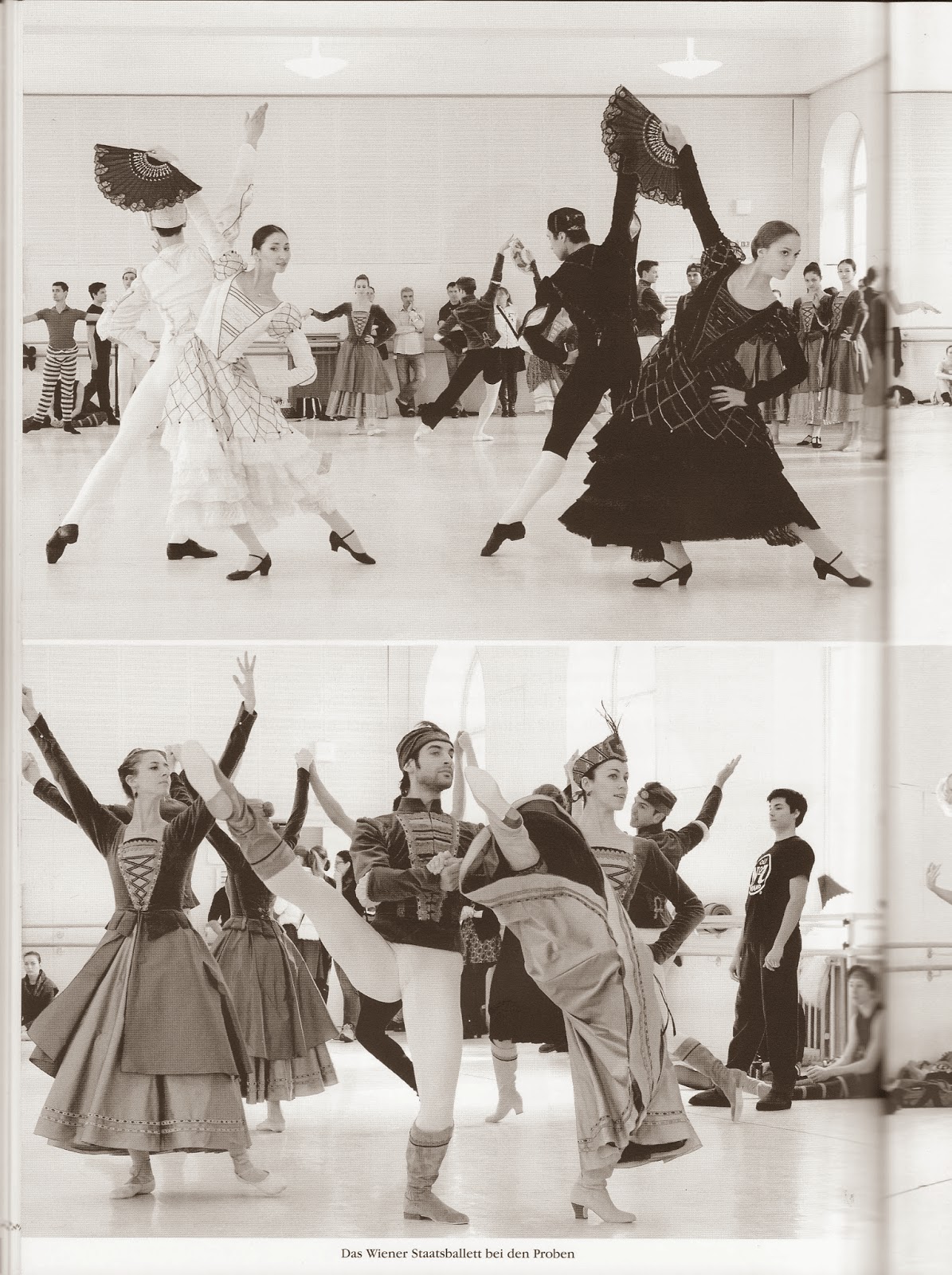
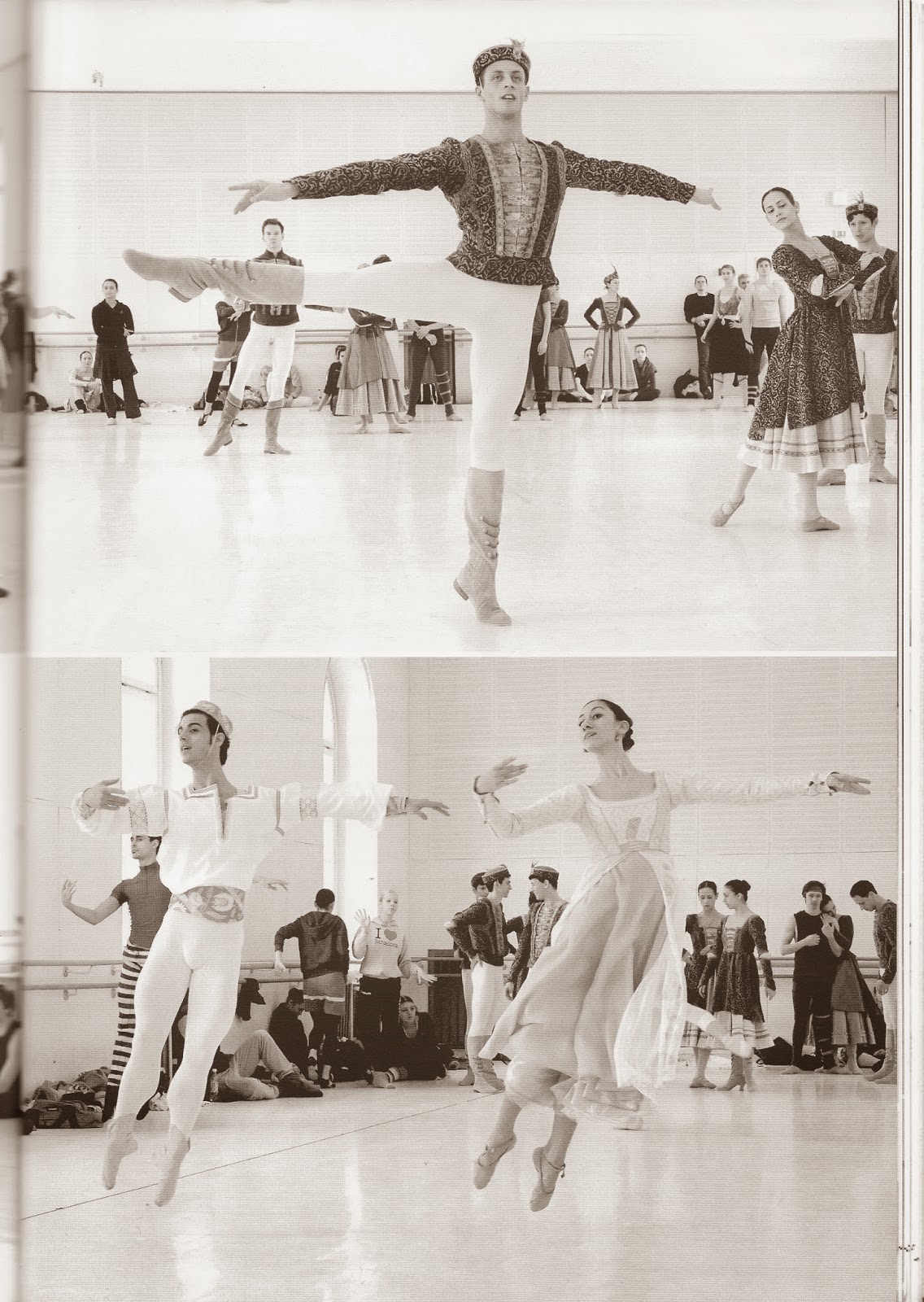
Wiener Staatsballet: February 19th, Premiére "Le Pavillon d'Armide" & "Le Sacre"
A première is always exciting.
This one was not supposed to be really very exciting for me:
I am not really a great fan of Neumeier’s work and I had the seen the general rehearsal last Friday.
But still…
I was very surprised.
Le Pavillon d’Armide
Before I start writing about what I have witnessed last night, I will break a rule.
Well, rules are made to be broken, at least mine are… by me: I always write about the main roles at the very end of a review but this time I must start with the words MIHAIL SOSNOVSCHI BRILLIANT!
Yes and even this adjective is still not really expressing what we witnessed yesterday with his interpretation of the tortured Nijinsky's soul.
This evening will be remembered because of him.
We all know dancers that are good actors but Mr. Sosnovschi’s performance was just “a notch above that”.
All of a sudden I realized that tears were running down my face with his interpretation.
Emotions… who could ask for anything more?
At a sort of career “top moment” (the moment in which a person reaches maturity but is still young enough to perform) he gave us a very sensible portrait of a tortured soul. Mr. Sosnovschi, an intelligent dancer that uses technique just as a tool for his artistry, he faced without fears the technical difficulties of the role (am I right that I witnessed twice triple tour-en-lairs?) and concentrated more in the character, telling the audience a “story”, making us eager to learn more about it.
A very intelligent reading of Nijinky's personality and character. The highest peak of this evening.
I dedicate this review to this most touching performance. I am glad that I could take part on it! Thank you.
Viennese audiences may be a bit over challenged by a piece that requires so much information and knowledge about ballet:
in the mad scenes there are many references to the original Nijinsky’s choreographies of “Faun”, “Petrouschka” and “Sacre”. But does the audience realize this?
If someone does not understand which roles Romola and Sergey Diaghilew (strangely mentioned in the programme as “Serge”) played in Nijinsky’s life, they'll miss a lot of the plot.
If someone does not know who Tamara Karsavina and Alexandra Baldina were and what “la danse siamoise”, the one movement from the Ballet Suite “Les orientales” represented for Nijinsky’s own sexuality, they are in troube.
If someone is not informed about his bipolarity. Then they’ll have a problem watching this show.
Neumeier’s language in Pavillon (which I had never seen before) reminded me of the same “formula” that he used in his “Dame aux Camelias”.
In “Dame” he uses fictional characters (Manon and Des Grieux) in pas de trois (with Marguerite) and even pas de quatres (including Des Grieux).
In “Pavillon” he does not use only fictional characters like the dancer from “dance siamoise”
(majestically played by Davide Dato – a dancer that never stops to surprise me… the thrill of the sensuality of this dance shivered the whole audience. I had to be sure about that, so I looked up in the dictionary: Shiver: a shudder felt down one's back, due to either fear, anticipation, nervousness, or excitement)
and Armide, played very securely by Nina Polakova.
But also Nijinsky himself as a dancer (Denny Cherevychlo’s first entrance is a moment of pure poetry. Later he once more amazed the audience with his technique and stamina),
Tamara Karsavina (very well played “in the character” by Maria Yakovleva although a bit insecure technically),
Alexandra Baldina (danced with a certain emotional aloofness but with great technical certainty by Nina Tonoli),
Sergey Diaghliew (wonderfully danced and well interpreted by Roman Lazik, that also played the doctor - a fact that seems to have confused many people. A very sensible dancer).
Nijinky and Diaghilew the PDD: Perhaps the most beautiful and openly homoreotic pas de deux in Neumeier’s repertoire. The kiss that Diaghlew places in his hand and puts on Nijinsky’s lips is a moment of pure emotion.
In the “present” Nijinsky is in company oh his wife Romola, very dramatically played by the very sensible and talented Nina Polakova that not only wore the most elegant gown of the evening but displayed emotions on stage that are not so usual in dancing. A beautiful, touching performance!
Choreographically speaking I found the connections from Nijinsky at the present to Nijinsky as a dance pupil quite difficult to follow.
If you’d not know that this dancer (Richard Szabó) was supposed to be Nijinsky as a young boy, you would not understand it. Perhaps the very different looks of Mr. Szabó compared to the classical fairness of Mr. Sosnovschi don’t give us the hint. A matter of wrong casting. A younger dancer like Mr. Wielick, that looks much more alike to Mr. Sosnovchi, would have suited the role much better.
Another interesting point that reminded me extremely of “La dame aux camelias”: the walkers in the park… It is so interesting to follow the phases in a choreographer’s career and find the similarities in works that they have done within the same period of creativy.
More to that later.
Le Sacre,
is not one my favourite pieces. Having been choreographed in 1972 it has become “dated” with all those endless repetitions of queues and rows and endless “passing through” back and forth, between each other’s legs. Over and under each other. It is so “dated” in its resolutions (unlike Cranko’s pas de deux, for example) and not an easy piece to dance.
And I am glad that I had never to learn how to “count” the music (although I love it!).
It is really not a very comfortable piece for the dancers. Especially for the corps de Ballet. That is why I start this piece of my review (again breaking an own rule) by writing of my biggest admiration and respect to dancers like Suzan Oppermann, Alaia Rogers, Céline Janou Weder, Laura Nistor, Leonardo Basilio, Marcin Dempc, Marian Furnica, Greig Matthews, Tristan Ridel, Dumitru Taran, Alexandru Tcacenco, Zsolt Törok, Géraud Wielick and other members of the cast. This piece is harder to play than to do a “Jane Fonda’s aerobic class” of the 80’s!
For me personally there are no “main roles” in “Sacre”. Sometimes I think that the last solo (danced, by the way, beautifully and with the stamina of a bull by Rebecca Horner) was just an excuse to pick “a name” as a “marquee name” to attract audiences back in the 70's. I am glad that Miss Horner is getting such roles - not an easy dancer to cast - she is neither the lyrical nor the classical "on you toe type" Ballerina. Quite difficult to imagine her in more "formal" productions but she seems to exceed in such productions, like the two Neumeier's choreographies in which she has been casted in the last two last years. But they are, unfortunately, very selden in the Opera's repertoire.
Back to the solo (is she going to be sacrificed or is she killing herself? That was never, since the 70's, clear to me!): We cannot forget that we are talking about 1972 and Neumeier was not so known at those times (later that solo would even be played by a dancer that was complete naked, I think her name was Beatriz Cordua).
But, also here, these are athe similarities during a choreographer’s period, which I wrote about while commenting on “Pavillon” and “La Dame aux Camelias”. This endless display of “power”, the repetitious hard movement solutions, the constant strength required for this last solo (that amazes audiences) reminds me of the last “Wife’s solo” in "Joseph’s legend".
It has the same language line, except for the endless running.
Funny how choreographer’s stick to something for such a long while.
Although I sometimes thing that the “young choreographer’s vocabulary” (he was young at the time) was perhaps too short.
And this brings a sort of inarticulateness at the end of the creative process.
Nevertheless it was wonderful to witness once more the versatility of dancers that can do anything: Ioana Avraam, Alice Firenze and Eszter Ledan – wild, ferocious in fact, with their hair open, as well as the strength of Masayu Kimoto, Eno Peci and especially Francesco Costa, a young dancer that is turning into a very fine dancer – in such a short time.
A dancer with an extremely masculine presence and charisma on stage.
To add to all that we cannot leave unmentioned Michael Boder’s conducting. Always a pleasure.
A very enjoyable night.
All pictures, except Nijinsky's "Dance Siamoise": Copyright Ashley Taylor / Wiener Staatsballet. With my kindest Thanks.
Mostrando postagens com marcador Peci Eno. Mostrar todas as postagens
segunda-feira, 20 de fevereiro de 2017
quarta-feira, 1 de abril de 2015
Wiener Staatsoper: Josephs Legende (Davide Dato & Ketevan Papava)
Sometimes the power of Marketing and Advertisement can be quite underestimated... History shows us many examples, art history even more. It takes just that certain, precise and (very) lucky moment to be on the right spot at the right time…
Just a few weeks ago marvellous Denys Cherevychko had one of the biggest hits of his career with Neumeier’s “Joseph’s Legend”. Definitely a very well-deserved success. No question about that.
But everything can be interpreted from different points of view and to my particular taste, I feel that the marketing Machinery of the State Opera performed perhaps a “bit too well” with him and overlooked a lot another precious performance.
The whole (ballet) media work concentrated on both Mr. Cherevychko’s and Miss Horner’s performances (culminating at their presence at the Opera Ball, which was quite unusual, especially if considering that Miss Horner is not a soloist), neglecting a bit the “other cast” - no expressions like "second cast" here - that was also performing.
Performing splendidly, by the way, as you’ll be able to witness in the following video – a new, beautiful work from Balàzs Delbo (© Delbeau Film).
The splendid performances from dancers like Davide Dato, Ketevan Papava and Eno Peci were not as talked about and discussed as they would have deserved.
One thing is more than clear: their rendition is of another sort. One cannot talk about “a notch above” but surely of subtleness. Intelligent subtleness. Another “reading” of the same theme.
In order to avoid any misunderstandings, I am just ALSO trying to highlight Mr. Dato’s and Miss Ketevan’s performances. I surely loved Mr. Cherevychko and Miss Horner but I still believe that there is place enough in the Media to accommodate different, marvellous interpretations of the same role, even if given by other performers. Think about the ABT, New York City Ballet, Covent Garden and the Paris Opera and the different Auroras, Giselles and Albrechts, Odettes and Odilles, Basils and Kitris from each and every Season…
This “richness” of choice teaches the audiences to think more compare, learn, ponder, develop healthy criticism… and not take anything for granted!
Audiences here are in quite a desperate need of learning that.
Unfortunately our “Austrian way of thinking” is quite “passé” specially concerning the contemplation of different talents.
Our world nowadays offers us so many talents and unlimited possibilities – it is quite normal to have different interpretations and “readings” of a same role at the same time… but we do not seem to adapt to that.
Passed and gone are the times in which only existed a “Nureyev”, or just one “Baryshnikov or perhaps a “Makarova”.
Unfortunately austrian audiences (and Press) tend to keep attached to this old-fashioned idea that there only exists one talent at the time…
and the media work, in this particular case of "Joseph`s Legend, reflected just that.
Times have changed, audiences all over the world too and so should we…
Let’s think about that…
P.S. I would like very much to point to the wonderful rehearsal pictures. © Ashley Taylor – you will surely hear this name quite frequently in the future.
DAVIDE DATO AS JOSEPH from DelbeauFilm on Vimeo.
Marcadores:
Ballet,
Cherevychko Denys,
Dato Davide,
Neumeier John,
Papava Ketevan,
Peci Eno,
Wiener Staatsoper
quarta-feira, 30 de abril de 2014
"Ein Reigen" (Volksoper, April 29th 2014): Premiere and repetitiveness...
At first, after watching yesterday’s performance and talking to many dancers, in and out of the cast, during the after-Premiere party, I thought of not writing a review about the Show. It seemed utterly unfair.
Today I have decided otherwise. My “dilemma” in relation to “Ein Reigen” lies not on the talent of so many young dancers but somewhere else… I will try to explain why.
“Der Reigen” was one of the biggest theatre scandals in the 20th Century and was, after the “Schnitzler’s Trial”, forbidden on Austrian stages until 1982 (even though Films and Records were produced).
“Ein Reigen” , loosely based on “Der Reigen” from Arthur Schnitzler, differs primarily from the original in the story-telling’s main line… In the play all characters “meet” in “pre- and post-coital” situations. In yesterday’s ballet all characters have obvious “love/sex” scenes – unfortunately most of them extremely repetitious. After the second there was no more “surprise” (nor thrill) for the audience.
Monsieur Manuel Legris said in his speech after the show that it is very hard to find someone who’d accept to stage a full-length Ballet.
He is absolutely right.
To fill a whole evening’s programme one’s “choreographical vocabulary” must be extensive, huge in fact. Unfortunately this was not the case. Ashley Page’s choreography is not only repetitious but lacks completely the “ups and downs” that give rhythm to a “script”. After a while the story-telling became boring… not inventive, not challenging, not dynamic. All this added to a very questionable music score: Surely wonderful works from Mahler, Zemlinsky, Korngold, Berg etc. ON THEIR OWN – but all of them - especially put together - extremely gloomy and nearly depressing.
Once more very repetitious.
Perhaps the only “brilliant” use of music was Ravel’s La Valse at the very End of the Show. “La Valse” which, in fact, was never a success when used for a ballet – even though history shows us the many choreographers who envisioned this piece as “dance stuff”.
The concept of using “celebrities” makes it quite confusing and bothered me. I personally would have preferred the use of “fictious” characters (like played by Alice Firenze - see photo above) instead of Freud, Mahler, Kokoschka, Alma Mahler, Schönberg, Schiele etc… Here we are again into that English craze, apart from the big “cliché” which these characters bring along with, of trying to “use” Ballet as a platform for other forms of art, not using the language of dance but simply the “script form” of a play… MacMillan’s “Mayerling” is one of the best examples of how confusing this can be.
History books have their own language – so should Ballet (And do audiences and even the dancers really know all about who is being portrayed? Today's world pace is too quick to assimilate all that we should... )
One positive thing must be said about Mr. Page: His very pointed feeling for casting. Knowing the company, I enjoyed (nearly most) of his casting.
But...
...I still have not revealed the main point about deciding so late about writing a review about yesterday’s show or not.
It can be seasily described in simple three words:
Lack of Rehearsals.
Audience could feel that in many parts of the show the dancers were insecure (never “ending” movements) and very uncertain (especially musically). I was sitting beside another dancer and sometimes we’d look sadly at each other…
I am sure that with some more rehearsal this ballet may turn into a good one – even though I question why it was put on the stage of the Volksopera. Need of a financial magnet for tourists in having a ballet about “Vienna”?
It could be… I wonder if it will survive this season.
Even so I could witness again the lovely stage presence of Suzan Oppermann (on whom I could concentrate a lot!), Clara Soley, Flavia Soares (elegance), Gala Aura Jovanovic (exceptional in a “trouser’s role”), Ioana Avraam, Maria Alati (very daring! I like that), beautiful Denys Chrevychko (unfortunately dressed in a horrible costume) and Kirill Kourlaev.
Surprisingly enough for me was the fact that Mr. Roman Lazik, a dancer that I consider extremely “blasé” on stage, managed to show at last some emotion.
Eno Peçi and Dagmar Kronberger, great professionals who would never, for a single second, let the audience see a glimpse of discomfort or insecurity. I enjoyed especially to witness again their dancing together.
Ketevan Papava had the difficult (and notorious) Alma Mahler to portray. And she did a very good job out of the very ungrateful choreography that was given to her.
But three dancers outshone completely the rest of the company:
Eszter Ledán (Emilie Flöge), that seemed to have arrived directly out of the past and looked like a reincarnation of the famous Klimt’s portrait (so sorry I do not have a picture of Miss Ledán in this role),
Alice Firenze (Mitzi, a prostitute), full of strength, power, interpretation’s understanding.
It is needless to write about both dancer’s splendid technique.
and Misha Sosnovschi (here with Maria Alati as Wally Neuzil) , that gave life to Egon Schiele and had one of the best parts, choreographically and dramatically observed, of the show.
I can well imagine what a creative, construtive and committed “worker” Mr. Sosnovschi is.
Feeling “responsible” for his work (he is the one that has to go on stage and show to the audiences what the choreopgrapher created) he is surely the dream for every choreographer to work with.
Participation. That's the secret of a real artist...
Apart from his splandid technique and stage presence. I like that...
The use of the revolving stage of the Volksopera was no surprise.
Neither for the rest of the audience nor for me.
Once again the factor “repetitiveness” playing a role.
Sceneries were good but the costumes were excellent – even though they could be described as too “Volksopera affine”
(Both by Anthony McDonald.
BUT...
...one last question remains unaswered for me:
hasn’t “Wien, Wien, nur Du allein” (Maurice Béjart) a much greater “insight” into the Viennese gloomy, very depressive moods? Prostitution, Betrayal, Prater, Tarot cards, Murder…
In 1990 I had the privilege to watch this (marvelous) show (Marcia Haydée, Jorge Donn) at the State Opera.
It received very mild applause…
Yesterday’s applause was also lukewarm…
Do Viennese really want to see themselves portrayed?
Copyrights: Pictures from the Volksopera's programme and Thomas Schulz (Many Thanks, dear Thomas)
quarta-feira, 19 de março de 2014
Swan Lake’s second show of the Season: March 18th 2014
What to expect? Nureyev’s 1964 Version of Lake is not one of my favorites… even though it was modified in 1984 into a new Version for the Paris Opera, it was never changed for the State Opera in Vienna, the very city in which it had its world premiere in 1964 (with Fonteyn and Nureyev getting a record of 89 curtain calls).
Tradition plays a big role in this country even when it is questionable and prevents improvements…
In 1964, having danced already in different versions of “Lake” (including Royal Ballet’s , masterly done by Ashton) Nureyev decided to move the main focus of the story from the Swan(s) to Siegfried. Also a very questionable decision…
To my opinion, Nureyev’s ego was so big that he committed the mistake of turning a “woman’s ballet” into one in which the danseur is the center of attractions… a very egocentric reaction.
For instance, one of the most beautiful and lyrical moments in ballet history is the very end of the 2nd act-pas de deux (in which Odette slowly turns one pirouette, makes a developée, turns then two pirouettes to make another developée and finish her 3 or 4 turns, falling to the side into the arms of Siegfried - take a look at the programme's cover, it's there - and then “falls” into an arabesque penchée in which her hand falls slowly at the very last note of music). But this does not exist for Nureyev… He simply moved the limelight away from the ballerina in one of her most significative moments and made Siegfried perform a short solo instead – to some other music! Ghastly!
On the following video you can see exactly what I mean, about the End of the 2nd act-pas de deux:
Vladimir Shishov & Liudmila Kononalova in a Gala, last year! And the end of the Adagio just like I described above...
But back to March 18th... Nureyev's use of music is also very questionable – we are not accustomed to it especially in the Black Swan’s pas de Deux. I have read once that this was supposedly so in the original score by Tchaikowsky. But I could never found real evidence of that…
It is definitely interesting to compare yesterday’s performance with the 1966 video… How technique and physical ideals have changed… strange: I don’t remember Fonteyn doing the 32 Fouettés EVER in the third act – I believe she never could do them… I’ll have to watch that video again
Yesterday the curtain went up and nothing really happened. Not at first. Even if the stage was full of people. The same way it would later happen during the Opening of the third act. There was some walking around but no acting, no energy, no feeling. As in many parts of the show yesterday, it seemed to take quite a long time before dancers could “enter” their roles, “warm-up” inside them. But there were exceptions.
One of the greatest exceptions of the above mentioned phenomenon is Vladimir Shishov. Really feeling “at home” within Siegfried’s soul, he showed us that this is HIS role.
No question about it.
A grown-up man performing a grown-up man. In complete command of the character, Mr. Shishov showed to us how right he is for this role. Without any phoney sentimentality or pretense he didn’t attitudinized the character. Much on the contrary: in certain moments (known to me from the 1966 film that was made in Vienna) even Nureyev exaggerates in his right to be a central figure. He is simply too often on stage (in comparison to other versions). Mr. Shishov’s more human incarnation of the Siegfried-persona turns him into a more believable character.
One of the fine things about this role is also his very supportive ways concerning Odette/Odille. The Danseur has also to be a great partner and Mr. Shishov is definitely one (and of course exactly the same way like he is a "danseur noble")!
Just the kind of dancer that leaves us calm and relaxed while he is partnering because we know that the ballerina is in very good hands.
After some months of sick leave Liudmila Konovalova (Elle est mignon!!!!) had to jump into yesterday’s performance because Olga Esina unfortunately hurt herself during the premiere on the 16th: after not having seen her on stage for a long while I felt unease during her first moments as Odette.
Wasn’t she, Odette, supposed to feel afraid during her first meeting with Siegfried?
She wasn’t so… but I had just forgotten that Miss Kononalova is NOT the fearful type of dancer. Her interpretation was cleverly adapted by her to her own personality without losing any of its assets.
During the second act I felt that she sometimes hurried a bit, that she was a bit ahead of the music and that small nuances of the role were not being completely used to the end. This feeling passed with time… perhaps it was due to some nervousness after being for so long away from the stage. But fact is that she gave us a marvelous portrayal of Odette and especially Odille. The audience was static.
At the End of the performance Miss Kononalova and Mr. Shishov received a long, standing ovation.
Very well-deserved indeed.
The Corps de Ballet disappointed me a bit during the second act. Especially during the crucial long parts in which the dancers have to stay still, not looking stiff, for a long time one could see that there is still a lot of work to be done: different head positions, arms that were too much high bent. But most of all I missed the lack of discipline during those long moments: many dancers were following the principals with their eyes and some even with their heads.
This should have been noticed during rehearsals, but… were there enough rehearsals?
Paying long attention to lovely Swan, Miss Flavia Soares, I caught myself wishing that there would be more discipline, like hers. She shows insight, beauty in her performance... but of course she is much more experienced than some of the teen-agers that are having their first season with the ballet. Experience cannot be replaced.
Siegfried’s “friends” Ioanna Avraam, Kiyoka Hashimoto, Greig Matthews and Dumitru Taran were the next thing closer to perfection - Synchrony, clean techniques, joy, personality, interpretation. Dancers that entered the stage and had no need to warm-up into their characters! Beautiful!
The little swans (even if for some there should be a "pas de chat urgent rehearsal") brought down the house: Maria Alati, Ioanna Avraam, Rui Tamai and lovely Eszter Ledán performed beautifully. Miss Ledán’s stage presence with her charm and lovely looks that are combined with a strong technique becomes clearer every day. She was also a delight as one of the noble young ladies that are presented to the prince: contrary to others she never left her role, even during the long “waiting” while The Black Swan and the Prince are performing.
The big Swans were beautifully performed, especially by Prisca Zeisel, a talented and very versatile young Ballerina who not only represents all the sweetness of a swan but also gave to the audience a very spirited performance as the Spanish Dancer (bellow) on Act III.
The hungarian dance was a delight – like a firework. But what else could you expect from the lively combination between Alice Firenze and Mihail Sosnovschi? (above) Both remind me somehow of tigers ... feline, strong, elegant… One can feel the joy and fun that both are having while performing. But wasn’t Callas, with all her strength, also called “La Tigresa”?
Oh, by the way; there is another expression that was once said by Fred Astaire about Cyd Charisse that would apply very well to Miss Firenze and Mr. Sosnovschi: beautiful dynamite!!!!!!!!
The polish dance was masterly performed by athletic Alexis Forabosco (bellow), using his legs to the very best even though the choreography is a bit boring – but definitely not so tedious like the neapolitan dance.
But what could one expect? The music belongs to the more tediously uninteresting pieces that Tchaikowsky ever composed! And so is the choreography: not worth mentioning.
Costumes by Luisa Spinatelli have not caused such an impact on me. In fact I think that the tutus in the second act could have been a bit fuller – and the tops more harmonically cut. Also Odette’s Headdress left much to be desired – it simply did not “caress” enough Miss Konovalova’s face.
Except perhaps for The Queen Mother’s (Dagmar Kronberger) exquisite headdresses on both the 1st and the 3rd Acts.
Rotbart’s (Eno Peci) costume that was so often mentioned was OK (but the headdress made him look more like a cock). Unfortunately Rotbart’s performance is resumed to a bit more than running around in a sort of frenzy… but let us be honest: would Nureyev create rivalry for himself on stage? He was much more preoccupied in creating his Siegfried than choreographing many parts and other roles of “Swan Lake”…
Resuming last evening: it was a very rewarding experience… experiencing so many talents that at the same time made me try to analyze more and more the complexity if this work and Nureyev’s motives.
But there was one most disturbing fact that was quite clear to me: Dancers are looking tired… and it is still too early in the Season for that. What is happening? Olga Esina injured herself, Davide Dato broke his foot... This is something to think about...
P.S. all pictures except Miss Soares' taken from the Wiener Staatsballet's programme.
Miss Soares' picture kindly permmited by Mr.Thomas Schulz. Thank you!
P.S.2 and just now, kindly sent by Davide Dato, this lovely picture. When Mr. Shishov went on his knees to give Miss Konovalova these flowers, the audience went mad!!!!!!!
quarta-feira, 12 de dezembro de 2012
Wiener Staatsballet: 2012,Nov 30th: MEISTERWERKE DES 20. JAHRHUNDERTS
Before you start reading the text bellow, please notice that I have nearly no pictures of THIS particular performance. That is the reason why I have used other dancers’ in order to illustrate this performance.
One November 30th I had the privilege (and luck) to receive 2 tickets for the Opera from my friend Vladimir Shishov. After a hard week full of problems and hard work, I was really looking forward to a relaxing evening… I had much more than that!
The seats were marvelous, exactly in the fourth row, even though quite unusual for me: I normally choose seats on the first balcony for the Ballet… I like to be a bit “above” the stage. Unfortunately it is not always a pleasure to sit there and be aware of the formations which are usually intended by the choreographer… last March at “Glass pieces” the company hadn’t been properly rehearsed for the 3rd piece (a part of “Echnaton” from Glass) and I nearly regretted to be seated in my favourite box of the Opera…
Anyways, this time I had a completely different experience: not only has the company been “growing and growing” in artistic terms, repertoire and internationality, it has been working a lot… and rehearsing a lot… and DANCING a lot! Monsieur Legris…
The first part of the evening – and main reason of this review - “Suite en Blanc”(Serge Lifar) is one of my all-time favourites. I hadn’t seen this ballet in years until it premiered again in Vienna last February. I was at that time very much impressed with Shane Wuerthner’s performance (bellow with Liudmila Konovalova and Alexis Forabosco). Unforgettable.
When the curtain opened, guess whom I saw first. My dear frined Flavia Soares, her delicate fairy-like figure and inimitable smile. What a pleasure!
Copyright: Wiener Staatsoper
Once more Vladimir Shishov (above) showed us why he is in the Premieur Danseur rank. His stage presence, his “Persona” shines… When he enters on stage, the whole Opera House seems to belong to him. He demands our full concentration… and everything seems to be done at such ease, with incredible naturality and poise:
Premier Danseur. It could not be any othe way.
He and Olga Esina (below) were marvelous at the “Adage”.
Mais uma vez Vladimir Shoshov (acima) nos mostrou o porque do seu Status de Premieur Danseur. Sua presença no palco, sua “persona” brilha… Quando ele entra no palco, toda a Ópera parece lhe pertencer. Ele atrai toda a nossa concentração… e tudo parece ser feito com facilidade, com incrível naturalidade e porte: Premier Danseur. Não poderia ser de outra forma.
Ele e Olga Esina (abaixo) estiveram maravilhosos no “Adage”. "Poise" is the key-word.
Copyright: Wiener Staatsoper
I was also very impressed with Denys Cherevychko’s (below) strong performance in “La Mazurka” (Denys was a short time ago at the Paris Opera as Basil in “Don Quixote” ).
Always a pleasure to look at, Davide Dato (“Pas de Cinq”), “growing” more and more and everyday as an artist. Every time I see him on stage, he surprises me agin.
Exact, technically stronger every day and a beautiful, dynamic personality on stage.
Enchanting Prisca Zeisel (below), one of the few Austrians in the company, impressed the public with her musicality and lines in “Thème varié”).
Precious Precociousness!
Copyright: Wiener Staatsoper.
Copyright: Wiener Staatsoper
The revelation of the evening for me was Alexis Forabosco (below).
Although I had seen him already many times on stage, this time I sort of “concentrated” more on his performance, he caught my full attention. His French background and technique give him a full understanding of “Suite” – combine these qualities and add presence, musicality and beautiful lines, mix them on a stage while slowly adding the music of Edouard Lalo and you’ll have what just delighted me and the audience on the last November 30th in “Thème varié”.
A beautiful performance by a very gifted and very sensual dancer. Bravo, Monsieur Forabosco.
Copyright: Wiener Staatsoper
After the first intermission another “jewel” by the Swedish choreographer Nils Christe. Inventive work to a very difficult music from Bohuslav Martinu – really VERY difficult.
Two of the dancers which had just only been on stage in “Suite” were again on stage. Much energy required after the technically demanding “

Copyright: Wiener Staatsoper
Above Eno Peçi & Ketevan Papaya as well as Misha Sosnovischi in “Nightfall”.
Unfortunately the evening came to an end with “L’Arlésienne” (below) which I consider a boring ballet, a big bore really – as many others from Roland Petit.
This choreography does not appeal to me at all. And the evening should have started and not finished with it.
But this review is coming to an end and I would like to dedicate to the Prima-Ballerina Cristina Martinelli, who danced (the full version of “Suite en Blanc” for the firsttime in Brazil) at the "Adage". Unfortunately the only time it was ever shown in Brazil, at Rio de Janeiro’s “Theatro Municipal”, her artistic home for many, many years... During which she reigned as Brazil's "Majesty"!
Cristina Martinelli's private collection.
terça-feira, 20 de março de 2012
Wiener Staatsoper: Balanchine & Robbins (e a adorável arrogancia de Manuel Legris!)
No dia 16 passado, estive na Ópera de Viena para assistir uma Gala de “Balanchine & Robbins”, coreógrafos, genios, artistas incomparáveis…
Antes da apresentação um habitual Champagne no Bar do Hotel Sacher, papos e até piadas… (p.s. aqui já estávamos na Ópera, para "mais um" champagne... )
Conhecem o que contou Beatrice Arthur (lembram dela? Das “Golden Girls”?) sobre Jerome Robbins? Não?
Ela disse abertamente num Show seu: "The man was a genius, but he really wasn't a very nice person. Actually, he was the only director who ever made me cry. He was really a dreadful human being" (foto abaixo).
O programa reuniu quatro Ballets: “Glass Pieces” e “In the Night” – o único que eu não conhecia e que me encantou – ambos de Jerome Robbins, genio conhecido no cinema pela sua maravilhosa coreografia de “West Side Story” (no Brasil “Amor, sublime Amor”).
e “Stravinsky Violin Concerto” e “Themes and Variations” estes de George Balanchine (in short, Mr. B., foto acima) e com os quais tenho uma relação de certa forma “oblíqua”.
“Violin Concerto” é “oficialmente de 1972” mas poucos sabem que Mr.B. retrabalhou um Ballet que tinha tido sua Première em 1941 em New York, só dez anos depois de “Violin Concerto” ter sido composto por Stravinsky! Esta empoeirada peça de museu chamou-se na época “Balustrade” e, além de contar com a presença do próprio Igor (Stravinsly) regendo a orquestra, foi dançado pela “pérola negra” Tamara Toumanova (mais sobre ela brevemente) e por uma jovem Tatiana Leskova – que este ano celebrará seu nonagésimo aniversário. Fui seu aluno. Ela mesmo me deu esta “Charge” que uma vez comentei – acho que apaguei a Tertúlia quando ela fez mais uma de suas grosserias comigo...
"Coices" não fazem parte da minha filosofia de vida... Agora, a "pessoa histórica" Leskova é interessantíssima. A pessoa histórica.
De qualquer forma: Tatiana e Tamara ao lado de Mr. B e Stravinsky himself… Não é divina a charge?
Bem, comecemos “a descacar um abacaxi”
“Glass Pieces” é um trabalho chato e presunçoso… Ele tenta ser “contemporaneo” todo o tempo e acaba nos deixando a impressão de que o que foi tentado todo o tempo, não se realizou. Complexos por causa do trabalho de Twyla Tharp? No Idea... Não sei realmente qual a intenção de Robbins foi, principalmente musicalmente… Não sou fã da música de Philipp Glass: as duas primeiras partes (“Rubric” e “Façades”) são infinitamente chatas… lembrando até os programas da (finada) Rádio Jornal do Brasil FM…
Shane A. Wuerthner me chamou muito a atenção na primeira parte – por sua forma de interpretar e entender Robbins… Não sei de que compania Shane vem, mas ele é americano e – querendo ou não – tem mais experiencia com o trabalho do NYCB.
Na segunda parte, práticamente um Pas-de-Deux, Olga Esina – bailarina famosa no momento, da nova geração - estava excelente e Kirill Kourlaev, e seu magnífico físico, como sempre muito correto.
Olga tem uma coisa comparável, em termos de “secura”, à Antoinette Sibley… seu perfil as vezes “delata” isso… Mas este é o problema de uma pessoa que muito se “encosta” só na técnica… My opinion...
Musicalmente a terceira parte é mais interessante (uma parte de “Echnaton” de Glass) mas eu me assustei com a falta de ensaio do Corps-de-Ballet. Esta falha foi de certa forma tão óbvia e visível, que até Erich, que me acompanhou e não é uma pessoa “de Ballet”, notou… Linhas, filas, direções, principalmente as cabeças não foram respeitadas e devidamente ensaiadas… infelizmente uma Performance muito “suja”. Eu pensei… Se continuar assim, vou para casa!
O seguinte Ballet iria porém me recompensar o “fiasco” do primeiro. A única obra que eu não conhecia “In the Night” foi a que mais me fascinou.
Nocturnos de Chopin…
Tres Pas-de-Deux…
Uma «quarta parte» na qual todos os tres casais dividem o mesmo Nocturno (O número 2 op.9, meu predileto).
A musicalidade e delicadeza da coreografia me impressionaram demasiado! Que trabalho mais complexo e mesmo assim, trabalho que “passa” toda uma simplicidade que, nós sabemos, só è alcançada à base de muito ensaio e trabalho… Chapeaux!
O segundo Pas-de-Deux foi dançado por bailarinos que não conhecia e que estavam fazendo seu “Debùt” na Ópera: Alena Klochkova e Igor Milos – escrevam estes nomes, voces ouvirão deles no futuro…
A “estrela” maior foi para mim o incrível Eno Peci. Bailarino da Albania, muito inteligente, perspicaz, brilhante e MUITO versátil… como leremos em seguida… Uma estrela de grande bilho!!!!!
Então chegou o momento esperado por mim “Stravinsky’s Violin Concerto” (e minha comparação é com um DVD que tenho de uma velhíssima e maravilhosa “fita de vídeo” com Peter Martins… ). Fiquei deliciado com o que assisti… Temos que comentar uma coisa antes e para explicar o que quero dizer, tenho que me referir a um comentário de um tenista sobre Björn Borg (sim, juro!). Ele disse: “We are playing Tennis, he’s playing something ele!”.
E é exatamente assim que me sinto em relação à Dança de Mr.B.! Não é nada fácil dançar seus Ballets se voce não teve o devido “treino” (de anos) da escola do New York City Ballet… Tarefa comparável à dificuldade de aprender o real estilo de Bournville… Admiro a coragem de todos estes bailarinos da Ópera, entrando em terreno tão desconhecido, ajudados por uma certa «arrogancia» (no bom sentido) de Manuel Legris – que está fazendo um trabalho maravilhoso com o Corps-de-Ballet da Ópera aqui… Agora, quem não tenta não consegue (ou não falha) e é por este motivo que admiro esta sua arrogancia de colocar todos estes bailarinos, que tem uma escola “do leste”, dançando coisas do NYCB que nem Bailarinos do ABT (American Ballet Theatre) se atreveriam a dançar!!!!! Chapeau, Monsieur Legris!
Olga Esina teve momentos maravilhosos – e dificílimos por sinal. Muito trabalho a frente ainda para poder “entender” Balanchine… Mas quando penso em Olga como “Aurora”, outra bailarina… e então aqui, numa fantástica performance no que eu considero um Balanchine “danadinho”. Parabéns!
Nina Poláková me surpreendeu. Não “sigo” muito sua carreira, seus “passos”… Mas ela me tirou a respiração algumas vezes…
O querido do público, "L'enfant Terrible” da Ópera de Viena, Mihail Sosnovschi, demonstrou mas uma vez que ele pode fazer o que quer… Bailarino talvez de proporções físicas não muito clássicas, ele nos faz (assim como Haydée fazia) esquecer destas “trivialidades”, destes "pormenores" e nos coloca baixo uma corrente elétrica de alta voltagem enquanto dança… Apesar de uns “russismos circenses” nos braços – que não tem muito o que ver com o estilo de Balanchine – ele deu uma ótima apresentação…
Já há muito queria aqui fazer uma homenagem a ele… Bem, vamos ver o que encontro para publicar brevemente!
Emocionado me deixou a Performance de Eno Peçi – que antes do intervalo principal já nos tinha regalado com um grande “presente” de sensibilidade em “In the Night”. De todos os bailarinos da noite foi nele que vi o maior trabalho em termos de estilo Balanchiniano… Foi ele o que mais alcançou esta “metamorfose” de “bailarino clássico” que se transforma em “bailarino clássico de Balanchine”. Que linhas e principalmente que braços !!!!! Foi um grandíssimo prazer assistí-lo !
A parte final começou e eu já sabia que seria o maior sucesso com o público (e inclusive com Erich): Temas e Variações, uma obra de Mr.B. da qual realmente desgosto…
Tinha a esperança de que Vladimir Shishov danæasse a parte principal – pois Vladimir, a quem conheço pessoalmente – faz de qualquer coreografia uma obra de arte.
Infelizmente um bailarino nada apropriado para este trabalho, Denys Cherevychko, interpretou o “Lead”. Não vejo Cherevychko, neste tipo de papéis. Para mim, por causa do seu físico, ele seria um ótimo bailarino de caráter… Nada mais.
Este é um fato da realidade que deve ser reconhecido - por mais que doa...
Como gostaria de ter assistido Vladimir! (foto abaixo)
Duas pessoas ainda faço questão de mencionar aqui: Não porque seja uma amiga pessoal, mas a linda Flavia Soares realmente “desponta” no Corps-de-Ballet… Não tenho uma foto apropriada de sua particpação em “Temas e Variações” por isto colocarei outras aqui…
Ela possui uma coisa muito, muito especial no palco. Uma luz, uma simpatia, uma beleza (muito Audrey por sinal) combinadas com uma certa seriedade, linhas de fazer inveja à qualquer “Prima” e uma ótima técnica! Uma bonita personalidade no palco e é isso o que o público busca… Aquela coisa especial, aquele “it” que não pode ser descrito em simples palavras…
Outra “Luz” para meus olhos foi o jovem Greig Matthews:
despontando aqui desde alguns meses (acho que só desde setembro) este jovem menino escoces de 18 anos mostrou – (nos dois Ballets de Mr.B.) o que é “style”… Acho que, junto a Shane A. Wuerthner, ele era realmente um dos únicos que intuitivamente sabiam o que é realmente interpretar Mr. B. & Robbins…
O "Resumée":
mais uma “Night at the Opera” e uma noite adorável…. Esta foto no Bar do "Sacher" depois do espetáculo. Erich, Obrigado pelo convite!
Antes da apresentação um habitual Champagne no Bar do Hotel Sacher, papos e até piadas… (p.s. aqui já estávamos na Ópera, para "mais um" champagne... )
Conhecem o que contou Beatrice Arthur (lembram dela? Das “Golden Girls”?) sobre Jerome Robbins? Não?
Ela disse abertamente num Show seu: "The man was a genius, but he really wasn't a very nice person. Actually, he was the only director who ever made me cry. He was really a dreadful human being" (foto abaixo).
O programa reuniu quatro Ballets: “Glass Pieces” e “In the Night” – o único que eu não conhecia e que me encantou – ambos de Jerome Robbins, genio conhecido no cinema pela sua maravilhosa coreografia de “West Side Story” (no Brasil “Amor, sublime Amor”).
e “Stravinsky Violin Concerto” e “Themes and Variations” estes de George Balanchine (in short, Mr. B., foto acima) e com os quais tenho uma relação de certa forma “oblíqua”.
“Violin Concerto” é “oficialmente de 1972” mas poucos sabem que Mr.B. retrabalhou um Ballet que tinha tido sua Première em 1941 em New York, só dez anos depois de “Violin Concerto” ter sido composto por Stravinsky! Esta empoeirada peça de museu chamou-se na época “Balustrade” e, além de contar com a presença do próprio Igor (Stravinsly) regendo a orquestra, foi dançado pela “pérola negra” Tamara Toumanova (mais sobre ela brevemente) e por uma jovem Tatiana Leskova – que este ano celebrará seu nonagésimo aniversário. Fui seu aluno. Ela mesmo me deu esta “Charge” que uma vez comentei – acho que apaguei a Tertúlia quando ela fez mais uma de suas grosserias comigo...
"Coices" não fazem parte da minha filosofia de vida... Agora, a "pessoa histórica" Leskova é interessantíssima. A pessoa histórica.
De qualquer forma: Tatiana e Tamara ao lado de Mr. B e Stravinsky himself… Não é divina a charge?
Bem, comecemos “a descacar um abacaxi”
“Glass Pieces” é um trabalho chato e presunçoso… Ele tenta ser “contemporaneo” todo o tempo e acaba nos deixando a impressão de que o que foi tentado todo o tempo, não se realizou. Complexos por causa do trabalho de Twyla Tharp? No Idea... Não sei realmente qual a intenção de Robbins foi, principalmente musicalmente… Não sou fã da música de Philipp Glass: as duas primeiras partes (“Rubric” e “Façades”) são infinitamente chatas… lembrando até os programas da (finada) Rádio Jornal do Brasil FM…
Shane A. Wuerthner me chamou muito a atenção na primeira parte – por sua forma de interpretar e entender Robbins… Não sei de que compania Shane vem, mas ele é americano e – querendo ou não – tem mais experiencia com o trabalho do NYCB.
Na segunda parte, práticamente um Pas-de-Deux, Olga Esina – bailarina famosa no momento, da nova geração - estava excelente e Kirill Kourlaev, e seu magnífico físico, como sempre muito correto.
Olga tem uma coisa comparável, em termos de “secura”, à Antoinette Sibley… seu perfil as vezes “delata” isso… Mas este é o problema de uma pessoa que muito se “encosta” só na técnica… My opinion...
Musicalmente a terceira parte é mais interessante (uma parte de “Echnaton” de Glass) mas eu me assustei com a falta de ensaio do Corps-de-Ballet. Esta falha foi de certa forma tão óbvia e visível, que até Erich, que me acompanhou e não é uma pessoa “de Ballet”, notou… Linhas, filas, direções, principalmente as cabeças não foram respeitadas e devidamente ensaiadas… infelizmente uma Performance muito “suja”. Eu pensei… Se continuar assim, vou para casa!
O seguinte Ballet iria porém me recompensar o “fiasco” do primeiro. A única obra que eu não conhecia “In the Night” foi a que mais me fascinou.
Nocturnos de Chopin…
Tres Pas-de-Deux…
Uma «quarta parte» na qual todos os tres casais dividem o mesmo Nocturno (O número 2 op.9, meu predileto).
A musicalidade e delicadeza da coreografia me impressionaram demasiado! Que trabalho mais complexo e mesmo assim, trabalho que “passa” toda uma simplicidade que, nós sabemos, só è alcançada à base de muito ensaio e trabalho… Chapeaux!
O segundo Pas-de-Deux foi dançado por bailarinos que não conhecia e que estavam fazendo seu “Debùt” na Ópera: Alena Klochkova e Igor Milos – escrevam estes nomes, voces ouvirão deles no futuro…
A “estrela” maior foi para mim o incrível Eno Peci. Bailarino da Albania, muito inteligente, perspicaz, brilhante e MUITO versátil… como leremos em seguida… Uma estrela de grande bilho!!!!!
Então chegou o momento esperado por mim “Stravinsky’s Violin Concerto” (e minha comparação é com um DVD que tenho de uma velhíssima e maravilhosa “fita de vídeo” com Peter Martins… ). Fiquei deliciado com o que assisti… Temos que comentar uma coisa antes e para explicar o que quero dizer, tenho que me referir a um comentário de um tenista sobre Björn Borg (sim, juro!). Ele disse: “We are playing Tennis, he’s playing something ele!”.
E é exatamente assim que me sinto em relação à Dança de Mr.B.! Não é nada fácil dançar seus Ballets se voce não teve o devido “treino” (de anos) da escola do New York City Ballet… Tarefa comparável à dificuldade de aprender o real estilo de Bournville… Admiro a coragem de todos estes bailarinos da Ópera, entrando em terreno tão desconhecido, ajudados por uma certa «arrogancia» (no bom sentido) de Manuel Legris – que está fazendo um trabalho maravilhoso com o Corps-de-Ballet da Ópera aqui… Agora, quem não tenta não consegue (ou não falha) e é por este motivo que admiro esta sua arrogancia de colocar todos estes bailarinos, que tem uma escola “do leste”, dançando coisas do NYCB que nem Bailarinos do ABT (American Ballet Theatre) se atreveriam a dançar!!!!! Chapeau, Monsieur Legris!
Olga Esina teve momentos maravilhosos – e dificílimos por sinal. Muito trabalho a frente ainda para poder “entender” Balanchine… Mas quando penso em Olga como “Aurora”, outra bailarina… e então aqui, numa fantástica performance no que eu considero um Balanchine “danadinho”. Parabéns!
Nina Poláková me surpreendeu. Não “sigo” muito sua carreira, seus “passos”… Mas ela me tirou a respiração algumas vezes…
O querido do público, "L'enfant Terrible” da Ópera de Viena, Mihail Sosnovschi, demonstrou mas uma vez que ele pode fazer o que quer… Bailarino talvez de proporções físicas não muito clássicas, ele nos faz (assim como Haydée fazia) esquecer destas “trivialidades”, destes "pormenores" e nos coloca baixo uma corrente elétrica de alta voltagem enquanto dança… Apesar de uns “russismos circenses” nos braços – que não tem muito o que ver com o estilo de Balanchine – ele deu uma ótima apresentação…
Já há muito queria aqui fazer uma homenagem a ele… Bem, vamos ver o que encontro para publicar brevemente!
Emocionado me deixou a Performance de Eno Peçi – que antes do intervalo principal já nos tinha regalado com um grande “presente” de sensibilidade em “In the Night”. De todos os bailarinos da noite foi nele que vi o maior trabalho em termos de estilo Balanchiniano… Foi ele o que mais alcançou esta “metamorfose” de “bailarino clássico” que se transforma em “bailarino clássico de Balanchine”. Que linhas e principalmente que braços !!!!! Foi um grandíssimo prazer assistí-lo !
A parte final começou e eu já sabia que seria o maior sucesso com o público (e inclusive com Erich): Temas e Variações, uma obra de Mr.B. da qual realmente desgosto…
Tinha a esperança de que Vladimir Shishov danæasse a parte principal – pois Vladimir, a quem conheço pessoalmente – faz de qualquer coreografia uma obra de arte.
Infelizmente um bailarino nada apropriado para este trabalho, Denys Cherevychko, interpretou o “Lead”. Não vejo Cherevychko, neste tipo de papéis. Para mim, por causa do seu físico, ele seria um ótimo bailarino de caráter… Nada mais.
Este é um fato da realidade que deve ser reconhecido - por mais que doa...
Como gostaria de ter assistido Vladimir! (foto abaixo)
Duas pessoas ainda faço questão de mencionar aqui: Não porque seja uma amiga pessoal, mas a linda Flavia Soares realmente “desponta” no Corps-de-Ballet… Não tenho uma foto apropriada de sua particpação em “Temas e Variações” por isto colocarei outras aqui…
Ela possui uma coisa muito, muito especial no palco. Uma luz, uma simpatia, uma beleza (muito Audrey por sinal) combinadas com uma certa seriedade, linhas de fazer inveja à qualquer “Prima” e uma ótima técnica! Uma bonita personalidade no palco e é isso o que o público busca… Aquela coisa especial, aquele “it” que não pode ser descrito em simples palavras…
Outra “Luz” para meus olhos foi o jovem Greig Matthews:
despontando aqui desde alguns meses (acho que só desde setembro) este jovem menino escoces de 18 anos mostrou – (nos dois Ballets de Mr.B.) o que é “style”… Acho que, junto a Shane A. Wuerthner, ele era realmente um dos únicos que intuitivamente sabiam o que é realmente interpretar Mr. B. & Robbins…
O "Resumée":
mais uma “Night at the Opera” e uma noite adorável…. Esta foto no Bar do "Sacher" depois do espetáculo. Erich, Obrigado pelo convite!
Assinar:
Postagens (Atom)