Mostrando postagens com marcador Dato Davide. Mostrar todas as postagens

quinta-feira, 23 de março de 2017

Wiener Staatsballet: March 22nd, 2017. "Onegin" revisited.


For me Onegin is and always will be one the most sensitive works ever made for ballet. It may sound ridiculous – due to the fact that it is based on Pushkin’s lyrical work – but it is pure poetry... Poetry perfectly translated into ballet by John Cranko, for me until today one of the great genius of last century’s ballet – his work will live forever: I always begin, all over again, to admire immensely his “pas de deux solutions” and group scenes, as if I had never seen them before. And his personal way of building the characters into dance and into the story-telling… more to that a little bit later.

Maria Yakovleva/Roman Lazik: Copyright Wiener Staatsoper/ Ashley Taylor

I was very pleased with the Corps-de-Ballet. Last time I had seen this production I thought that a lot of the precision Cranko put in his work was missing and lots of work should be done: directions, heads and – mostly – arms… that single precision that this South-African brought to life... But yesterday’s performance showed that the company has been working very hard on “style & precision”. And that made me glad! Very glad indeed! So many new faces in the company, which I am not able to distinguish from each other or, better put it this way, faces to which I cannot yet add a name to. I have to write about the ones nobody ever writes about – I have space enough, here on this online platform – and I do not have to reduce my reviews to a few sentences...

Wonderful work by Elena Bottaro (always a joy to look at!), Suzan Opperman, Céline Janou Weder (both such “pros”) and Alaia Rogers (who gave us a beautiful and precise “mirror reflection” of Tatjana – showing through her face all the thoughts, doubts and feelings of the main character! No an easy task). But we all agree that we would love to have a mirror reflection just like Miss Roger's face!

The same applies to the boys – growing very strongly as a group, in complete “unison” with each other.
I have the feeling that between male dancers there are not so many “new faces” and I’d like to mention the names on which an audience can always “rely on” (and put “their feet up and relax because of the good work): Marat Davletshin, Marcin Demp, Alexis Forabosco (that will dance Gremin soon… I guess I’ll have to return to the Opera sooner than I thought!), Igor Milos, Tristan Ridel, James Stephens, Dumitru Taran, Zsolt Törok, Jaimy van Overeem and Géraud Wielick. Dancers you can really rely on. I do not remember – in all years I have been in Vienna, well... decades in fact, following Ballet here in Vienna – to have witnessed a moment in which the male dancers from the Corps-de-Ballet (many half soloists within the names I have mentioned) were so strong together. I like that! Awesome!

Nikisha Fogo, giving her début as Olga, gave a good performance – even though she must have been a bit nervous. But just as the curtain opened I felt that she “had the role” under control: in the scene in which she is doing some embroidery with her mother and foster mother, she was not doing affected movements as a dancer but really putting her strength in the fun of the movement without “pretending”. Sawing... She really was doing her embroidery. Her pas de deux with Lenski was the first “catchy” moment of the evening. Still, there is still some work to be done on this couple's "chemistry". But I am sure they will find it!
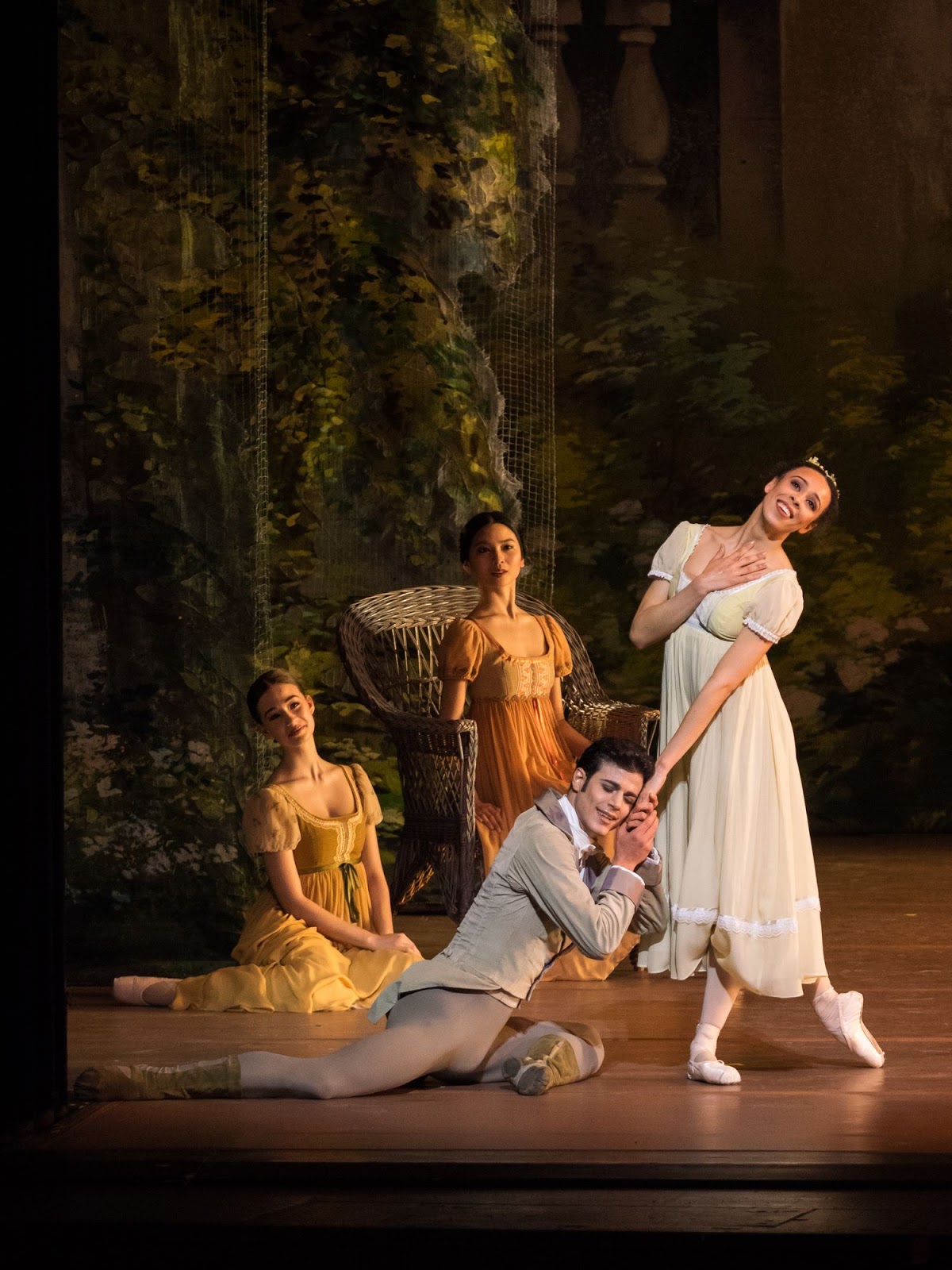
Nikisha Fogo/Davide Dato: copyright Wiener Staatsoper/Ashley Taylor.

Davide Dato who hasn’t stopped to delight his audiences – since 6 years (I just found a review that I wrote 5 years ago, in which I said “I am sure that we will be hearing from Mr. Dato very much in the future – I could not have been more right!) is at top form. But I always say this and he always gives performances that are “a notch above” the last one. Always “surpassing” the last performance. A gifted dancer and a very good actor. His Lenski is complete – down to the last details!

Davide Dato/Roman Lazik. Copyright: Wiener Staatsoper/Ashley Taylor.

For me the biggest “gift” of the evening was Alexandru (Sascha) Tcacenco as Gremin. I had never seen a Gremin that possessed such firmness and determination like this portrayal of the role. Dogmatic. Strong. After “decades” of watching Onegin I, at last, understood why Tatjana was so determined, in the last scene, in her way of sending Onegin away from her chambers. At last I understood the “bridge” that Cranko has thought of… the country girl that became the wife of an aristocrat learned also to “command” – because of his army-like behaviour… That is what I meant aat the beginning of this review. The line of story-telling and the way Cranko built his characters. But this was only possible because of Mr. Tcacenco’s performance. A dancer not only with a great stage presence but also with a great “insight” about the characters he’s playing, understanding them completely.


Alexandru Tcacenco/Maria Yakovleva: Copyright Wiener Staatsoper/Ashley Taylor

Maria Yakovleva and Roman Lazik were on their element.

Miss Yakovleva, looking beautifully frail, perhaps in the best role I have ever seen her in, gave us a sensitive portrayal of “haunted” Tatjana – down to the last details. Average audiences will not pay much attention to that – because THESE are no moments of “bravura” (and circus) onstage but, for example, her first “soliloquy” (bedroom scene) was a moment of pure art. The way she lies and moves in bed and then pretends to sleep while her foster mother enters the room, just to stand up a bit later to write on her desk… her thoughts and doubts and wishes symbolized by the mirror and the entrance of Onegin himself, in her dream. Miss Yakovleva delighted the audience – made us sometimes laugh, wonder and then cry… Her interpretation reminded me a lot of the character study that Marcia Haydée (the original Tatjana) did for her work. Insight. As a dancer and actress…
In fact, technique is not all, and those moments, in which the audience is simply “hypnotized” by such a touching performance are more worth than a trunk filled with diamonds and pearls - think about Cunegonde in "Candide".

Maria Yakovleva/Roman Lazik: Copyright Wiener Staatsoper/Ashley Taylor

Mr. Lazik – in the role of his life… that was my impression. And what else could I add to that? Not much. He knows all the dark sides of this character – but also, like he showed in the first act, his “dandy”, bored side. In a very well mastered interpretation, he turned Onegin, who in Russian literature would influence so many other Russian literary characters, into a real person. Flesh and blood. Onegin is a ballet that is not only perfect for him as a character but that also emphasizes his technique and his physique – long legs and very special arms.
A pure joy for Balletomanes – although sad, very sad: think about this quote that Pushkin wrote about Onegin's character: ““..depression still kept guard on him, and chased after him like a shadow - or like a faithful wife.” 

Onegin is a very “round” piece – a form I simply love – precise and compact. There are no “wasted moments”. Thank you, John Cranko!

segunda-feira, 20 de fevereiro de 2017

Wiener Staatsballet: February 19th, Premiére "Le Pavillon d'Armide" & "Le Sacre"

Wiener Staatsballet: February 19th, Premiére "Le Pavillon d'Armide" & "Le Sacre"

A première is always exciting.

This one was not supposed to be really very exciting for me:
I am not really a great fan of Neumeier’s work and I had the seen the general rehearsal last Friday.
But still…
I was very surprised.


Le Pavillon d’Armide

Before I start writing about what I have witnessed last night, I will break a rule.
Well, rules are made to be broken, at least mine are… by me: I always write about the main roles at the very end of a review but this time I must start with the words MIHAIL SOSNOVSCHI BRILLIANT!

Yes and even this adjective is still not really expressing what we witnessed yesterday with his interpretation of the tortured Nijinsky's soul.
This evening will be remembered because of him.

We all know dancers that are good actors but Mr. Sosnovschi’s performance was just “a notch above that”.


All of a sudden I realized that tears were running down my face with his interpretation.
Emotions… who could ask for anything more?
At a sort of career “top moment” (the moment in which a person reaches maturity but is still young enough to perform) he gave us a very sensible portrait of a tortured soul. Mr. Sosnovschi, an intelligent dancer that uses technique just as a tool for his artistry, he faced without fears the technical difficulties of the role (am I right that I witnessed twice triple tour-en-lairs?) and concentrated more in the character, telling the audience a “story”, making us eager to learn more about it.
A very intelligent reading of Nijinky's personality and character. The highest peak of this evening.
I dedicate this review to this most touching performance. I am glad that I could take part on it! Thank you.

Viennese audiences may be a bit over challenged by a piece that requires so much information and knowledge about ballet:
in the mad scenes there are many references to the original Nijinsky’s choreographies of “Faun”, “Petrouschka” and “Sacre”. But does the audience realize this?
If someone does not understand which roles Romola and Sergey Diaghilew (strangely mentioned in the programme as “Serge”) played in Nijinsky’s life, they'll miss a lot of the plot.
If someone does not know who Tamara Karsavina and Alexandra Baldina were and what “la danse siamoise”, the one movement from the Ballet Suite “Les orientales” represented for Nijinsky’s own sexuality, they are in troube.
If someone is not informed about his bipolarity. Then they’ll have a problem watching this show.

Neumeier’s language in Pavillon (which I had never seen before) reminded me of the same “formula” that he used in his “Dame aux Camelias”.
In “Dame” he uses fictional characters (Manon and Des Grieux) in pas de trois (with Marguerite) and even pas de quatres (including Des Grieux).


In “Pavillon” he does not use only fictional characters like the dancer from “dance siamoise”
(majestically played by Davide Dato – a dancer that never stops to surprise me… the thrill of the sensuality of this dance shivered the whole audience. I had to be sure about that, so I looked up in the dictionary: Shiver: a shudder felt down one's back, due to either fear, anticipation, nervousness, or excitement)
and Armide, played very securely by Nina Polakova.


But also Nijinsky himself as a dancer (Denny Cherevychlo’s first entrance is a moment of pure poetry. Later he once more amazed the audience with his technique and stamina),
Tamara Karsavina (very well played “in the character” by Maria Yakovleva although a bit insecure technically),
Alexandra Baldina (danced with a certain emotional aloofness but with great technical certainty by Nina Tonoli),
Sergey Diaghliew (wonderfully danced and well interpreted by Roman Lazik, that also played the doctor - a fact that seems to have confused many people. A very sensible dancer).


Nijinky and Diaghilew the PDD: Perhaps the most beautiful and openly homoreotic pas de deux in Neumeier’s repertoire. The kiss that Diaghlew places in his hand and puts on Nijinsky’s lips is a moment of pure emotion.


In the “present” Nijinsky is in company oh his wife Romola, very dramatically played by the very sensible and talented Nina Polakova that not only wore the most elegant gown of the evening but displayed emotions on stage that are not so usual in dancing. A beautiful, touching performance!

Choreographically speaking I found the connections from Nijinsky at the present to Nijinsky as a dance pupil quite difficult to follow.
If you’d not know that this dancer (Richard Szabó) was supposed to be Nijinsky as a young boy, you would not understand it. Perhaps the very different looks of Mr. Szabó compared to the classical fairness of Mr. Sosnovschi don’t give us the hint. A matter of wrong casting. A younger dancer like Mr. Wielick, that looks much more alike to Mr. Sosnovchi, would have suited the role much better.

Another interesting point that reminded me extremely of “La dame aux camelias”: the walkers in the park… It is so interesting to follow the phases in a choreographer’s career and find the similarities in works that they have done within the same period of creativy.
More to that later.

Le Sacre,
is not one my favourite pieces. Having been choreographed in 1972 it has become “dated” with all those endless repetitions of queues and rows and endless “passing through” back and forth, between each other’s legs. Over and under each other. It is so “dated” in its resolutions (unlike Cranko’s pas de deux, for example) and not an easy piece to dance.
And I am glad that I had never to learn how to “count” the music (although I love it!).
It is really not a very comfortable piece for the dancers. Especially for the corps de Ballet. That is why I start this piece of my review (again breaking an own rule) by writing of my biggest admiration and respect to dancers like Suzan Oppermann, Alaia Rogers, Céline Janou Weder, Laura Nistor, Leonardo Basilio, Marcin Dempc, Marian Furnica, Greig Matthews, Tristan Ridel, Dumitru Taran, Alexandru Tcacenco, Zsolt Törok, Géraud Wielick and other members of the cast. This piece is harder to play than to do a “Jane Fonda’s aerobic class” of the 80’s!

For me personally there are no “main roles” in “Sacre”. Sometimes I think that the last solo (danced, by the way, beautifully and with the stamina of a bull by Rebecca Horner) was just an excuse to pick “a name” as a “marquee name” to attract audiences back in the 70's. I am glad that Miss Horner is getting such roles - not an easy dancer to cast - she is neither the lyrical nor the classical "on you toe type" Ballerina. Quite difficult to imagine her in more "formal" productions but she seems to exceed in such productions, like the two Neumeier's choreographies in which she has been casted in the last two last years. But they are, unfortunately, very selden in the Opera's repertoire.


Back to the solo (is she going to be sacrificed or is she killing herself? That was never, since the 70's, clear to me!): We cannot forget that we are talking about 1972 and Neumeier was not so known at those times (later that solo would even be played by a dancer that was complete naked, I think her name was Beatriz Cordua).
But, also here, these are athe similarities during a choreographer’s period, which I wrote about while commenting on “Pavillon” and “La Dame aux Camelias”. This endless display of “power”, the repetitious hard movement solutions, the constant strength required for this last solo (that amazes audiences) reminds me of the last “Wife’s solo” in "Joseph’s legend".
It has the same language line, except for the endless running.
Funny how choreographer’s stick to something for such a long while.
Although I sometimes thing that the “young choreographer’s vocabulary” (he was young at the time) was perhaps too short.
And this brings a sort of inarticulateness at the end of the creative process.


Nevertheless it was wonderful to witness once more the versatility of dancers that can do anything: Ioana Avraam, Alice Firenze and Eszter Ledan – wild, ferocious in fact, with their hair open, as well as the strength of Masayu Kimoto, Eno Peci and especially Francesco Costa, a young dancer that is turning into a very fine dancer – in such a short time.
A dancer with an extremely masculine presence and charisma on stage.

To add to all that we cannot leave unmentioned Michael Boder’s conducting. Always a pleasure.
A very enjoyable night.

All pictures, except Nijinsky's "Dance Siamoise": Copyright Ashley Taylor / Wiener Staatsballet. With my kindest Thanks.

sexta-feira, 23 de dezembro de 2016

Wiener Staatsballet: December 22nd, 2016. "Raymonda" revisited.

Wiener Staatsballet: December 22nd, 2016. "Raymonda" revisited.

It had been years since I had last seen „Raymonda“. In fact I guess it was in the 80’s with Makarova & Bujones…

Yesterday’s performance was part of a very well supervised production, with good sets (nothing breathtaking but very effective), lovely costumes (special note to the black & white tutus of Raymonda’s girlfriends), “pleasant” ballet music (even with the never ending repetitious Glasunow’s cordals) but, to be very honest, through the passing of the years I had completely forgotten how “Raymonda” simply bores and tires me… Immensely.


Rudolph Nureyev repeats – like in his “Nutcracker” – the unnecessary choreographic “complications” that are very “ungrateful” to dancers and just happen to “please” the half a dozen true Ballet Connoisseurs that may happen to be visiting the performance that day. Even in other metropolis, in which there is a stronger following to Ballet - and a bigger understanding of it than in Vienna - the general public does “not get” these tricky, irrelevant obstacles that are strategically disposed throughout the ballet.

But this is only my point of view…

However there is some praise to be made to yesterday’s cast.

Nina Tonoli and Natascha Mair, two (very different) dancers in perfect “unison”, yes, exactly like in music: two or more musical parts sounding the same pitch… It has been some years since I have first started to “follow” their careers. With such an infinite joy... and I can keep on saying that they still always surprise me.
One can nearly “touch” the immense progress they have been making.

Copyright: Wiener Staatsoper/Michael Pöhn

Masayu Kimoto and Richard Szabó: what a fortunate combination of talents. Mr. Kimoto is the kind of dancer that really makes us believe in the joy he is having while dancing. Mr. Szabó – with a very pleasant new “look” that is not only most becoming but gave him a very distinguished aspect: longer, straight hair, combed to the back. Both gave very strong performances – even though I missed a little bit more of demi-plié in Mr. Szabó’s performance in order to equalize his (already very good) jumps to Mr. Kimoto’s.

What a pleasure to witness again lovely Gloria Maass as “the white Lady”. Wearing not only the most beautiful costume of the evening but also that inimitable grace and poise that is so natural to her, she simply "enchants"!
I do salute Mr. Legris’ decision of using the unique talents of this beautiful dancer again in this production.

Jakob Feyferlik: how can he do it? Every time I presence him onstage he seems to have grown more as an artist. Sometimes in just a question of a few weeks. Clean technique, very comfortable with his own “persona” onstage, Mr. Feyferlik is capturing more and more the audience’s attention. A brilliant future lies ahead of him.

Copyright: Wiener Staatsoper/ Michael Pöhn

Davide Dato – one of the Opera’s biggest and most gifted talents – gave once more a performance (as Abderachman) so filled with magnetism and exactitude that the audience was ecstatic. From beginning to end, every time he entered the stage this “thing” called magic happened again… and the rapport that he creates with the audience belongs to those moments that are turning more and more rare to witness. Great technique as a tool to artistry. Not great technique for the sake of great technique.

Copyright: Wiener Staatsoper/ Michael Pöhn

Last but not least Miss Nina Poláková. After yesterday’s performance one could really understand why she may be the logic choice to portray Raymonda. Even with the “obstacles” created by Mr. Nureyev, she was at complete ease with herself and gave an electric performance filled with power and delicacy at the same time. Miss Poláková does not forget for a single moment the character she is playing. She becomes completely the role. An artist. Even if the choreography requires many times lots of unnecessary complications – but I have already written about that.

It would be too much to extend these "thoughts" and mention every single dance from the corps de Ballet - many of them very gifted demi-soloists - but this time I feel like thanking the whole cast for such a professional and special "delivery" onstage yesterday. Chapeau!


Copyright: Balázs Delbó

segunda-feira, 21 de março de 2016

Wiener Staatsballet: Le Corsaire (World Première, Vienna, March 20th 2016)


The long awaited première. Perhaps the highest point of this Season in Vienna:
Manuel Legris' "Le Corsaire".


In contrary to a lady sitting next to me that has started making her notes at the middle of the third act, I have to go back a little in time in order to write not only about the dancers and the choreography but also about the production, the intellectual process and its “coming into life”.

As I have often commented, I like to arrive earlier at premières, as if "soaking" more of the atmosphere would underline more and more the excitement of a discovery, of witnessing something new. Premières are very special evenings, with lots of expectation in the air.

As a kind of “hobby” I like to analyze faces of certain members of the audience before, during and after the show... huge transformations can take place and be seen - depending on the grade of interested that a performance "exhales" and on the individual interest of many.
Extremely interesting.


The audience was full - full and filled with many "names" of the international dance panorama – especially from the Paris Opera - as well as ballet critics.

Some few weeks ago during an official "talk" at the Opera, Monsieur Legris told me personally:
"We are on the right way" - how right he was!
The challenge that Manuel Legris took is a fascinating one. A very honest one. Chapeau.

"Le Corsaire" was not in the repertoire of the Paris Opera, so in this case, as Monsieur Legris put it well, there were no possibilities of influences, just his plain understanding about the work and its complicated, very peculiar dynamic. Also his understanding about the characters should not be forgotten. The characters that we have witnessed yesterday on stage were far away of being just statues in a wax museum but characters with an own drive.
On the top of it all, I have to draw your attention to the point that, “Le Corsaire” is in itself an enormous challenge.
Its story telling-line is a very old-fashioned one, quite difficult to adapt to our present times. Also its constant use of pantomime presents another challenge – not only to dancers but also to the audiences (which are not used anymore to this kind of language). It is, as a full-evening ballet, a very complex piece of work and this regardless of the fact that the main line of the story is difficult to understand, even remember... I have rarely found someone who could "tell the story" of "Le Corsaire" without consulting either the libretto or some other sources of literature about it (or even without contradicting oneself).

Special mention should be made about Albert Mirzoyan, as assistant choreographer. As Mr. Legris put into words: “We are a good combination, the French and the Russian souls”. Mr. Mirzoyan is that kind of gentle character that exhales knowledge about ballet, art, history and is always in full-command of what he is doing. And this "at ease".
Such a blessing for our State Opera and for Mr. Legris to have such a gifted person, such an erudite, among his few co-workers. His work is not only of extreme importance for us but also to the Ballet world. As we have witnessed yesterday.

Lots of praise no Mr. Igor Zapravdin, responsible for the musical arrangements and his brilliant use of music from “L’Écumeur de mer” (also Adam) for the Odalisques and Slave Dances. Merely this distinctiveness turns this production into a “unique” one – without the confusing use of music from up to 11 different composers (like in many other productions), concentrating on Adam’s work – which in the case of “Le Corsaire” is not so brilliant as his “Giselle” but surely much more consistent when treated not so eclectically.

Luisa Spinatelli’s décor and costumes are a beautiful work of art and delicacy – with the only exception of the girl’s flowery headdresses during “Le jardin animé” that, from a certain distance, give more the impression of being hair-curlers than roses – a fact that was confirmed to me by an Stylist friend - especially on blonde dancers like Eszter Ledán or Suzan Oppermann.

Valery Ovsianikov’s conduction was at few times quite irregular. The tempo was either too fast (as during some fouettès that tossed Maria Jakovleva completely out of music) or too a bit too slowly (during a part of Miss Konovalova’s variation in the third act). But still, a brilliant Ballet conductor.

The following performances should be highlighted:

The Waltz on the third act was brilliantly performed by Oxana Kiyanenko, Eszter Ledán, Anita Manolova and Laura Nistor. An interesting, very lively piece of choreography that was beautifully executed by the four of them.


The three Odalisks danced by Natascha Mair, Nina Tonoli and Prisca Zeisel were a simple masterpiece of precision and joy. Three very gifted dancers, splendidly “on style” (as they have proved many times before) in perfect “unison” with each other. Not only a question of talent but also of emotional intelligence. Three dancers that really made their “homework”, thinking about the characters, adjusting to each other, talking about what they were doing. I like that. Congratulations to these exceptional talents.

Firenze/Dato. Copyright: Ashley taylor (Wiener Staatsoper)

Davide Dato and Alice Firenze were at their element as Birbanto and Zulméa: motion and fire. Every time they came on stage you had that certain (very well known) feeling of a “show-stopper”. And stop the show they really did.

Sosnovschi. Copyright: Ashley Taylor (Wiener Staatsoper)

Mihail Sosnovschi’s Seyd Pasha (another innovation by Mr. Legris that instead of having a laughable character as the Pascha decided for the more logical choice of a good looking man) left no impression. This non-dancing role is not quite adequate for Mr.Sosnovschi. His pantomime is too subtle, too understated, too “small” for that huge stage. He seemed bored. And this is quite unusual with Mr. Sosnovschi.

Kourlaev. Copyright: Ashley Taylor (Wiener Staatsoper)

On the other hand Lanquedem, as danced by Kirill Kourlaev, is a character to remember: Mr. Kourlaev’s total command of the stage, his beautiful technique (and of a very good pantomime) just made us sit back, relax and “put our feet up” to enjoy a performance without any fears that the dancer might not “make it”. A pleasure for everyone present. Vitality at its best. A danseur.

Gabdullin/Yakovleva. Copyright: Ashley Taylor (Wiener Staatsoper)

Unfortunately there was no chemistry between Robert Gabdullin and Maria Yakovleva.
I simply could not “buy it”, not believe the love story that was supposed to go on between the two of them onstage.
Mr. Gabdullin, an extremely gifted dancer with a very clean technique and beautiful lines, gave us a beautiful, daring and corageous Conrad. In every sense.
His special temperament and dramatization of the character were well idealized.
But there was no response from Médora, who seemed to be dancing alone and for herself: sometimes even giving the impression of walking “through”, allowing once in a while Conrad to touch her, support her.
I am looking forward to Mr. Gabdulli’s future.
Miss Yakovleva was correct as Médora, even without any sign of even trying to perform some pantomime BUT unfortunately with a strong tendency to the inelegance of over-extensions.
Even so a good part of the audience seemed to have liked her.

Konovalova. Copyright: Ashley Taylor (Wiener Staatsoper)

The real star of the evening, along with the choreography and production, was Liudmilla Konovalova as Gulnare. Very thin and looking better than ever, Miss Konovalova’s performance was one of pure joy. After having gone through two “turbulences” on the first act (because of bad partnering by the boys) she emerged as the Queen of the night. Complete in command of her technique she enjoyed the role the Gulnare with all its nuances. Such performances are rare. Performances that fill the audience with joy because of their sensibility, delicacy and strength at the same time and musicality (even adjusting without any effort to the wrong tempo, as mentioned above, given by the conductor).


No coincidence, that, during the bows, all of a sudden Miss Konovalova was center stage: the deserving queen of the evening! Bravo!

Mr. Legris work and legacy to the Ballet world, already immense, increased enormously after last night’s world Première. I wonder how long it will still take until this work is “framed” in its definite version.
At the moment it is already a brilliant piece of work - with quite intricate parts in, if I may say so, very good Nureyev tradition. Yes.

Legris/Mirzoyan and the whole ensemble. Copyright: Ashley Taylor (Wiener Staatsoper)

As Mr. Dominique Meyer mentioned during his speech in the after-Première Party: "this is an Opera House but the Ballet is now as important as the Opera..."


To be very honest, which Opera Director would/could not be happy about the financial aspect that is brought to the State Opera with the high occupancy, high percentage of seats sold for the ballet performances since the beginning of the "Legris Era"? Economically speaking this is a wonder - if you think about the sales' problems in the MET...

At this point, and to finish this long review, I would like to quote Dame Margot Fonteyn, a person whose thoughts about art I much admire:
"The first night is the worst possible time to make a hard and fast criticism: the baby never looks its best on the day it is born".

Thinking about that I would still like to add:
If this baby is already looking like this on its first night, so good, it is surely going to be a beauty, a star of first magnitude.


Film Copyright: Delbeau Films (Balázs Delbó)


...and coming soon!


Film Copyright: Delbeau Films (Balázs Delbó)

quarta-feira, 1 de abril de 2015

Wiener Staatsoper: Josephs Legende (Davide Dato & Ketevan Papava)


Sometimes the power of Marketing and Advertisement can be quite underestimated... History shows us many examples, art history even more. It takes just that certain, precise and (very) lucky moment to be on the right spot at the right time…

Just a few weeks ago marvellous Denys Cherevychko had one of the biggest hits of his career with Neumeier’s “Joseph’s Legend”. Definitely a very well-deserved success. No question about that.

But everything can be interpreted from different points of view and to my particular taste, I feel that the marketing Machinery of the State Opera performed perhaps a “bit too well” with him and overlooked a lot another precious performance.


The whole (ballet) media work concentrated on both Mr. Cherevychko’s and Miss Horner’s performances (culminating at their presence at the Opera Ball, which was quite unusual, especially if considering that Miss Horner is not a soloist), neglecting a bit the “other cast” - no expressions like "second cast" here - that was also performing.
Performing splendidly, by the way, as you’ll be able to witness in the following video – a new, beautiful work from Balàzs Delbo (© Delbeau Film).

The splendid performances from dancers like Davide Dato, Ketevan Papava and Eno Peci were not as talked about and discussed as they would have deserved.
One thing is more than clear: their rendition is of another sort. One cannot talk about “a notch above” but surely of subtleness. Intelligent subtleness. Another “reading” of the same theme.


In order to avoid any misunderstandings, I am just ALSO trying to highlight Mr. Dato’s and Miss Ketevan’s performances. I surely loved Mr. Cherevychko and Miss Horner but I still believe that there is place enough in the Media to accommodate different, marvellous interpretations of the same role, even if given by other performers. Think about the ABT, New York City Ballet, Covent Garden and the Paris Opera and the different Auroras, Giselles and Albrechts, Odettes and Odilles, Basils and Kitris from each and every Season…
This “richness” of choice teaches the audiences to think more compare, learn, ponder, develop healthy criticism… and not take anything for granted!
Audiences here are in quite a desperate need of learning that.

Unfortunately our “Austrian way of thinking” is quite “passé” specially concerning the contemplation of different talents.
Our world nowadays offers us so many talents and unlimited possibilities – it is quite normal to have different interpretations and “readings” of a same role at the same time… but we do not seem to adapt to that.


Passed and gone are the times in which only existed a “Nureyev”, or just one “Baryshnikov or perhaps a “Makarova”.
Unfortunately austrian audiences (and Press) tend to keep attached to this old-fashioned idea that there only exists one talent at the time…
and the media work, in this particular case of "Joseph`s Legend, reflected just that.
Times have changed, audiences all over the world too and so should we…

Let’s think about that…

P.S. I would like very much to point to the wonderful rehearsal pictures. © Ashley Taylor – you will surely hear this name quite frequently in the future.


DAVIDE DATO AS JOSEPH from DelbeauFilm on Vimeo.

quarta-feira, 12 de dezembro de 2012

Wiener Staatsballet: 2012,Nov 30th: MEISTERWERKE DES 20. JAHRHUNDERTS


Before you start reading the text bellow, please notice that I have nearly no pictures of THIS particular performance. That is the reason why I have used other dancers’ in order to illustrate this performance.


One November 30th I had the privilege (and luck) to receive 2 tickets for the Opera from my friend Vladimir Shishov. After a hard week full of problems and hard work, I was really looking forward to a relaxing evening… I had much more than that!


The seats were marvelous, exactly in the fourth row, even though quite unusual for me: I normally choose seats on the first balcony for the Ballet… I like to be a bit “above” the stage. Unfortunately it is not always a pleasure to sit there and be aware of the formations which are usually intended by the choreographer… last March at “Glass pieces” the company hadn’t been properly rehearsed for the 3rd piece (a part of “Echnaton” from Glass) and I nearly regretted to be seated in my favourite box of the Opera…


Anyways, this time I had a completely different experience: not only has the company been “growing and growing” in artistic terms, repertoire and internationality, it has been working a lot… and rehearsing a lot… and DANCING a lot! Monsieur Legris…
The first part of the evening – and main reason of this review - “Suite en Blanc”(Serge Lifar) is one of my all-time favourites. I hadn’t seen this ballet in years until it premiered again in Vienna last February. I was at that time very much impressed with Shane Wuerthner’s performance (bellow with Liudmila Konovalova and Alexis Forabosco). Unforgettable.

When the curtain opened, guess whom I saw first. My dear frined Flavia Soares, her delicate fairy-like figure and inimitable smile. What a pleasure!

Copyright: Wiener Staatsoper

Copyright: Wiener Staatsoper

Copyright: Wiener Staatsoper

Copyright: Wiener Staatsoper

Once more Vladimir Shishov (above) showed us why he is in the Premieur Danseur rank. His stage presence, his “Persona” shines… When he enters on stage, the whole Opera House seems to belong to him. He demands our full concentration… and everything seems to be done at such ease, with incredible naturality and poise:
Premier Danseur. It could not be any othe way.

He and Olga Esina (below) were marvelous at the “Adage”.

Mais uma vez Vladimir Shoshov (acima) nos mostrou o porque do seu Status de Premieur Danseur. Sua presença no palco, sua “persona” brilha… Quando ele entra no palco, toda a Ópera parece lhe pertencer. Ele atrai toda a nossa concentração… e tudo parece ser feito com facilidade, com incrível naturalidade e porte: Premier Danseur. Não poderia ser de outra forma.

Ele e Olga Esina (abaixo) estiveram maravilhosos no “Adage”. "Poise" is the key-word.

Copyright: Wiener Staatsoper

I was also very impressed with Denys Cherevychko’s (below) strong performance in “La Mazurka” (Denys was a short time ago at the Paris Opera as Basil in “Don Quixote” ).

Always a pleasure to look at, Davide Dato (“Pas de Cinq”), “growing” more and more and everyday as an artist. Every time I see him on stage, he surprises me agin.
Exact, technically stronger every day and a beautiful, dynamic personality on stage.

Enchanting Prisca Zeisel (below), one of the few Austrians in the company, impressed the public with her musicality and lines in “Thème varié”).
Precious Precociousness!

Copyright: Wiener Staatsoper.

Copyright: Wiener Staatsoper

The revelation of the evening for me was Alexis Forabosco (below).
Although I had seen him already many times on stage, this time I sort of “concentrated” more on his performance, he caught my full attention. His French background and technique give him a full understanding of “Suite” – combine these qualities and add presence, musicality and beautiful lines, mix them on a stage while slowly adding the music of Edouard Lalo and you’ll have what just delighted me and the audience on the last November 30th in “Thème varié”.
A beautiful performance by a very gifted and very sensual dancer. Bravo, Monsieur Forabosco.

Copyright: Wiener Staatsoper

After the first intermission another “jewel” by the Swedish choreographer Nils Christe. Inventive work to a very difficult music from Bohuslav Martinu – really VERY difficult.

Two of the dancers which had just only been on stage in “Suite” were again on stage. Much energy required after the technically demanding “
Copyright: Wiener Staatsoper

Copyright: Wiener Staatsoper

Copyright: Wiener Staatsoper

Copyright: Wiener Staatsoper

Above Eno Peçi & Ketevan Papaya as well as Misha Sosnovischi in “Nightfall”.

Unfortunately the evening came to an end with “L’Arlésienne” (below) which I consider a boring ballet, a big bore really – as many others from Roland Petit.
This choreography does not appeal to me at all. And the evening should have started and not finished with it.

But this review is coming to an end and I would like to dedicate to the Prima-Ballerina Cristina Martinelli, who danced (the full version of “Suite en Blanc” for the firsttime in Brazil) at the "Adage". Unfortunately the only time it was ever shown in Brazil, at Rio de Janeiro’s “Theatro Municipal”, her artistic home for many, many years... During which she reigned as Brazil's "Majesty"!

Cristina Martinelli's private collection.